
whatsapp-icon

The Important Differences between H1 and H2 Math

The Important Differences between H1 and H2 Math
The Important Differences between H1 and H2 MathEvery student in Singapore has had their fair share of experience with E-Math in their Secondary school days. But by the time we hit our upper Secondary years, we start getting the option to learn higher levels of mathematics, such as A math, E math and IP Math.

This progression goes on in JC as well with H1 and H2 Math. In some cases, some students may even have to complete H3 maths! The more in-depth the subject, the higher the course number. Depending on your natural abilities, you may find these JC subjects to be challenging, but there are ways to prepare yourself to take it on. To get you acquainted with these topics, here are the most important differences between H1 and H2 Math.

H1 and H2 Math Exam Paper Format

As a JC student, you understand the importance of preparing for your A levels mathematics exam. What may surprise you is how different the exam paper format is between H1 and H2 Math. Knowing this ahead of time will help you in your preparations as you’ll better know what to expect before you take the exam.

H1 Math Exam

The H1 mathematics exam consists of a single 3-hour paper. You will complete a variety of statistics and mathematics questions. The statistics questions are worth a total of 40 marks, while the pure mathematics section is worth 60 marks.

H2 Math Exam

On the other hand, the H2 mathematics exam is much more involved and comprehensive. It consists of two 3-hour papers. The first paper will evaluate your understanding of pure mathematics totally up to 100 marks. The second paper is a combination of both pure maths and statistics, each being worth 40 and 60 scores, respectively. The final weight is 40% for pure maths and 60% for statistics.

Although both the H1 and H2 math exams include pure maths and statistics, you’ll study some topics in H2 Math not included in H1 maths. That’s because JC H2 mathematics includes more in-depth and advanced concepts.

The main focuses of H1 mathematics include graphs, calculus, and statistics. Those studying H2 Math will also have to learn sequences and series, vectors, complex numbers, permutations/combinations, probability, differential equations, sampling, and hypothesis testing. As you can see, the number of topics required for the H2 math exam is much greater, and the application of these concepts is more intricate.

Is H1 Math Easier than H2 Math?

Many JC students are nervous about studying H2 mathematics, and they wonder if H1 is actually easier to grasp. The truth is that this answer varies from student to student. Some JC students feel that H1 is much easier if they have an additional maths background from secondary school. For example, some of the pure maths content may be repeated material that you already learned.

In H1 mathematics, only the statistics modules are new. Because of this, JC students learning H1 maths may have more time to devote to their other subjects. However, don’t let this fool you. H1 courses still have their hurdles each student must pass, but overall there are fewer topics to study.

Since H2 mathematics covers concepts not previously introduced, some JC students may feel overwhelmed. They may find themselves needing to devote much more of their study time to learning these new concepts and topics. It’s not necessarily more difficult, but H2 mathematics is definitely more concentrated.

Generally speaking, those who only study H1 mathematics intend to enrol into university courses that don’t require higher-level maths, such as business, social sciences, and economics. However, if you want to study physics or engineering, for example, you’ll need a more in-depth mathematics background to be successful, which make H2 Math a vital topic of study.

Why Is It Important to Know These Differences?

As previously stated, choosing between H1 and H2 Math ultimately depends on the university courses you want to study. Picking the right one will not only ensure you meet the requirements to apply, but it will also provide you with the solid foundational knowledge you need to help you succeed and excel on the university level.

Before you decide between H1 or H2 Math, visit the university website for which you want to apply to and understand the subject combination requirements. Some courses may require only H1 maths, but other courses ask for you to take the H2 exam before applying.

Scoring for Your H2 Math Papers

If you do choose to take on H2 Math and discover you need a helping hand grasping all these new concepts, you should look for H2 Math tuition as soon as you can. Since H2 Math requires the mastery of many topics, many JC students struggle to keep up with the syllabus. However, maths tuition increases the likelihood of you understanding the material and acing the courses.

Working with an H2 Math tutor will help you grasp each concept and be able to apply it when confronted with a question in the exams. They will break down the complicated concepts into small, more digestible bites.

H2 Math tuition also provides you with more practice scenarios. You can work at your own pace, and you’ll be able to achieve higher-order thinking. Learning from a different perspective will also help you gain better exposure and understanding.

At New Dawn Learning Studio we understand the difficulties faced by many students as they prepare for their H2 mathematics exam. That’s why we offer an open-concept design approach to tutoring. Our centre will give you the tools needed to master all the concepts presented in the H2 Math exam. Contact us to enrol into our tuition classes today

Paper Management for H2 Mathematics

Paper Management for H2 Mathematics
December 02, 2019 | By Yi Kai Paper Management for H2 MathematicsSEAB and Cambridge have recently decided to switch the format of the H2 mathematics paper to booklet form. This could be advantageous to those who usually miss out parts of the question. However, it also brings about the trouble of having to flip through pages which can often cause negligent students to make careless mistakes when transferring key steps. Not to worry though, we have a few tips that we teach our JC students in our A Level Math tuition classes that we would like to share with you today!

  1. Plan your presentation

Think of how and where you are going to write each key procedure. A Level Math questions often require you to work on smaller parts before combining everything together to get the final answer. Plan out where you would write each procedure and leave space between each procedure so that it would be clearer for the math examiners to read.

This would prevent you from being trapped in a situation where you are in the middle of an algebraic manipulation and have to go back and forth between the pages to copy your previous step. It also helps to eliminate the risk of making careless mistakes when transferring information.

  1. Make full use of rough paper given during the H2 math examination

As you would have guessed, H2 math questions are more advanced than O level math questions; they are not straightforward such that employing a single formula would be able to solve a question. More often than not, H2 math questions require heavy algebraic manipulation. As a result, unless you are confident that your answer doesn’t need any revisions, it is best to make use of rough paper.

Usually in the H2 mathematics exams, you would be provided with a piece of paper for rough workings. In the case where you do not receive paper, you can request for one. It is recommended to do the algebraic manipulations on rough paper first, and only when you have solved the math question, then do you transfer the answer over to the answer booklet. Not only would it make your answers look neater, but you would also be able to minimise careless mistakes when you transfer the answers over to the answer booklet.

  1. Scanning and analysing the questions

In the previous format where the entire question is presented nicely on the same page, you could easily read through the entire question. This would allow us to have a better sense of the answer and ensure that we do not have answers that overlap different parts. However, with the new format, it is harder to get a sense of the entire question especially since one question could span many pages. My advice would be to spend a little effort to scan through the whole question and get a general feel first. Don’t be lazy, this small effort would pay off by allowing you to better understand the question requirements.

  1. Graph sketching

When it comes to graph sketching, there are certain graphs that demonstrate symmetrical properties especially the even function graphs. Those who are not artistically inclined might be marked down on not demonstrating symmetry in their sketches (which is a pity). You might want to try folding the paper along the line of symmetry and draw one side of the curve first . This would cause an impression marking on the folded side of the paper and you could trace this marking to give a perfect mirror image.

The key to not being hindered by the new format of the paper is to practise and familiarize yourself with it. There are certain past year prelim H2 math questions and samples from SEAB that you could try. All in all, a few practices would go a long way in preparing you for the H2 Mathematics exams.

At New Dawn Learning Studio, our H2 math tuition classes are designed to shorten learning curves which will enable students to attain the desired grades in H2 Mathematics. Our experienced Math tutors will guide you along with common problems that JC student faced when taking A Levels.

RECOVERING FROM THE H2 MATHEMATICS PROMOS

RECOVERING FROM THE H2 MATHEMATICS PROMOS
RECOVERING FROM THE H2 MATHEMATICS PROMOSYour promo results for H2 math may not be up to your expectations though you have studied so hard. It may seem like you are destined to fail H2 math, but fret not, it’s not the end of the world and there are still ways to get back on track!


  1. Getting the fundamentals right

Most H2 math questions could not be tackled by a blind application of steps. H2 math requires JC students to be flexible in their approach and hence a good grasp of the concept is required before students can even apply them.

If you are lagging behind on J1 math topics, you should give your math lecture notes a revision and briefly study through them. Instead of just reading through line after line, try pondering the implications and understanding how to apply them. Allowing yourself to go deeper into the understanding of each topic. If you do not understand anything in your lecture notes, you should seek help immediately from either your JC math teachers or join in on H2 math tuition classes.

Moreover, lecture notes should be read in advance, it would also be good to put a lot of practice on example questions first. This way you would know which areas of the subject that you do not understand and could listen out for such areas during math lectures. You are better able to understand the theory and grasp the concepts quickly.

  1. Practice, practice, practice

Knowing of each math formula is but one thing, JC students need to understand how to apply the theory. My teachers would always say that math is like a machine, we need to oil it constantly or we will lose it completely.

JC students need a large exposure to as many math questions as possible, preparing them for possible questions that could come out in the H2 math exams and allowing them to better tackle difficult math questions. Moreover, it would teach students how to apply certain theories at the appropriate moment, which could be a headache for some. Practising would also allow students to gain speed in tackling math questions as they would be more aware of what to zoom into when the question is presented to them, familiarising their thought process with them such that they are able to think of possible methods quicker.

JC students are encouraged to develop a habit to practicing H2 math almost every day, we at New Dawn Learning Studio recommend out students to practice 3-5 questions per day. The tutorials are usually not comprehensive enough for students and are only a tool for the H2 math tutors to see if you understand the concept, and frankly speaking, to gauge if they need more practice. Good places to source H2 math questions could come from seniors and school’s photocopying shops that sell past year H2 math papers. I get most of mine from New Dawn Learning Studio, where the questions are sorted based on difficulty levels that are tailored to the individual. My advice when it comes to practising would be to slowly build up the difficulty level of math questions allowing slow and modest improvements while not demoralising oneself.

Before the exam period, you would want to practice topical math questions to have a better overview of the topic. However, approaching the prelims and A levels, it is recommended to switch to doing past year H2 math exams. Not only would it allow students to have ample practice across all topics but it also allows the familiarisation with the exam format and how math questions are phrased.

  1. Develop perseverance

There are always going to be difficult math questions out there that JC students can never run away. Trust me, with many friends who take further maths and H3 math, I have come to realise that they are good not solely because they are smart but also because they persevere when they see hard questions. Though the end goal is the answer, remember that students are also awarded for showing their methods. Students should not give up on the questions in the exam, hence, it is encouraged to students to build the habit of perseverance in their everyday practice.

When encountering a hard math question, do not immediately flip to the answer. Attempt it, if it requires a day then let it be, and try to tackle the math question from as many angles as possible. After struggling for a day or two, then look at the answer and understand it well. This would not only develop grit but it would allow you to better appreciate the method as well.

(Disclaimer, I would advise leaving such questions to the last in exams as to save time and maximise marks. Come back to it after you secured the other marks.

Prepare for H2 Math Exams Singapore

At New Dawn, the H2 math tuition classes would provide you with sufficient practices and develop your grit in tackling questions if you have difficulty in finding questions or give up easily. Most importantly, if you need to strengthen your understanding, New dawn would always be there to address the gaps with their constant support and comprehensive notes.

How to Prepare for Your A-Level Chemistry Exams

How to Prepare for Your A-Level Chemistry Exams

How to Prepare for Your A-Level Chemistry Exams

A-Levels are, without doubt, some of the most challenging exams that you can face as a student. It is therefore not surprising that you’ll find yourself needing assistance with some of the more challenging subjects such as H2 Chemistry! That’s why we’ve put together this little guide to help you plan just how you’re going to prepare for your A-level Chemistry exams.

The Challenges of A-Level H2 Chemistry

The main challenges that are presented with H2 Chemistry are the levels of in-depth knowledge that are required in order to pass the A-level exams. The emphasis in these exams is placed very much on understanding different scientific concepts and principles.

However, students have only a limited amount of time to build the required foundations and comprehension. As a result, additional Chemistry tuition is often required before the A-level exams to fully grasp everything you need to know.

The Elements of H2 Chemistry

H2 Chemistry comprises of two core elements, physical Chemistry and organic Chemistry and students are expected to have a sound understanding of both areas. In the physical Chemistry section, student’s must recognise that the syllabus places greater emphasis on both the knowledge and application of scientific principles with less focus on learning pure facts which experts believe does not display a full understanding of the topic matter.

Students will find that the H2 Chemistry syllabus initially begins with an extensive study of electronic configuration, the primary component on which the essential topics of chemical structure and bonding are based upon.

All students will be required to study composition and bonding and to develop a comprehensive knowledge of this particular field will be expected. Often, this is an area where students can benefit from further H2 Chemistry tuition as you will be required to predict trends in properties of matter and their reactions accurately.

As this is a complex topic, gaining additional guidance from a highly experienced and knowledgeable H2 Chemistry educator will be hugely beneficial. It will provide comprehensive and structured teaching to help you organise all this information, and make it more digestible.

It is this structure that facilitates a clear and sound understanding of the principles and applications surrounding H2 Chemistry. It is only with the foundation that students can gain the desired grades in A-Level Chemistry exams.

Preparation Methods

When you embark on your H2 Chemistry course, you will initially need to gain a detailed understanding of the atomic structure of elements and the bonding between different elements to form compounds. It is therefore vital that students develop easy to understand notes that come complete with detailed and thorough explanations as without these critical tools, excelling in the exams would be nearly impossible.

Once students have a sound understanding of atomic structure and bonding, the H2 Chemistry course will move towards a technical understanding of thermochemistry, thermodynamics and reaction kinetics.

This preparation will act as a foundation for Chemical equilibrium, including acid-base equilibrium and solubility equilibrium. It is a highly complex area within the A-Level Chemistry syllabus. It requires students to gain a deeper understanding of chemical reactions with more emphasis placed upon calculations and qualitative explanations.

How Joining an H2 Chemistry Tuition Can Improve Your Grades

A-Level H2 Chemistry is renowned for being a highly content-intensive subject. Students will be required to develop an in-depth understanding of the subject as well as being able to apply it to real-world situations in a practical sense. Students will be required to take detailed notes and be able to both ask and answer well-structured questions.

At New Dawn Learning Studio, our H2 Chemistry tuition is designed to shorten learning curves which will enable students to gain the desired grades in A-Level Chemistry. It is thanks to our experienced Chemistry tutors who will assist in answering challenging questions as well as guidance with problems that are frequently posed in exams.

How to Score For Your JC Math Exams

How to Score For Your JC Math Exams

How to Score For Your JC Math Exams

Making the jump from Secondary school math to JC level mathematics can be a daunting task, even if you’ve tackled A Math during your O Levels! Besides a much wider curriculum, the way you approach math is going to change completely!

To help you as you prepare to take on this challenge, or even if you’re already on it, we’ve gathered some helpful tips you can use to help you score on your upcoming JC H2 Math exams!

Have a Strong Foundation

When it comes to H2 math, it’s extremely important to understand concepts and theories, so that you’ll know where, and when to use them. This will be more challenging to identify than before because you’ll be working with so many concepts that can be applied in different ways, as opposed to Secondary math equations where there is one definite route to getting your answer.

At New Dawn Learning Studio, our objective is to solidify math foundations from even the secondary school level, so that students that enter their JC math lectures are prepared from day 1, which brings us to our next point on the importance of A Math.

Taking A Math Seriously

Students who wish to take H2 math in JC must take A math seriously–after all, it’s the closest practice to H2 Math that they will be able to experience. That’s why students have to familiarise themselves with formulas and their application while gaining a thorough understanding of why and how these theories and concepts are as such.

An overall understanding of A Math is required across several aspects of mathematics including, indices, surds, trigonometry along with differentiation and integration, all crucial aspects of modern mathematics. During the early year part of the calendar year, January and February, while waiting for JC Math admission after the completion of ‘O’ Levels, students should start spending time reviewing and revising A Math topics that they have found more challenging. It will help to make the transition to JC Math far less daunting.

Making Sure You Get it Right

The JC H2 math syllabus kicks off in March and doesn’t slow down from there, meaning that the course is quite intensive and extremely fast-paced! During lectures and tutorials, it is essential to be accustomed to different learning styles, something that they will need to adapt to in JC life. During lectures, which may accommodate as many as 300 to 400 students, students will be pushed to study and learn rather independently as their teachers can’t provide them with the personal attention that they might require.

We strongly advise that you take as many notes as you can during lectures so you can refer back to them at a later date, and ensure that you understand and identify everything you need to. It is perfectly normal for your concentration to waver, especially if you are finding the content difficult to understand. If this applies to you, seeking academic help at the earliest opportunity through guided tuition is recommended to ensure that you don’t fall too far behind–the sooner the better!

At New Dawn, we are well aware of the challenges that students face and, as such, we always plan to be one step ahead. We encourage students to join us before the academic year starts so that they have sufficient background knowledge before their lectures and mean that they are best equipped to absorb the information that is being presented to them.

Revision

Once formal lectures have been completed, we suggest that students use this period to revise the subject topic by topic. Revision is an essential part of reinforcing a student’s knowledge, skill and most importantly, understanding–something many students struggle with when it comes to H2 math.

A strong foundation will breed confidence and will give students an advantage, putting them in a position to be able to attempt even the more difficult questions that may get presented to them. Skipping questions and not answering them at all will seriously affect the final result that the student can achieve and as a consequence, they will receive lower grades.

The mid-year exam which will be taken in July is an excellent gauge of students’ abilities. It will highlight areas of weakness as well as the student’s strengths. The average score is between 40 and 50, which is considered as a “sub-pass”. Anything lower than 40 would suggest that the student urgently require H2 math tuition to help them to achieve a better final grade.

Why Study by Topic?

The reason for studying by topic is due to the Law of Exposure. The human mind is naturally receptive, so every time we are exposed to something, it effectively leaves an imprint on our brain. That’s why it’s important for students to get experience in dealing with an array of structures and question types so that they won’t get surprised or caught off in their exams, and get intimidated on the day! We all tend to neglect the way our brain functions and, therefore, don’t expose ourselves to as many questions as we should.

Besides quantity, it’s also a question of quality.  Here at New Dawn, we strive to give our students material that is up to date, so students have sufficient practice with materials that would greatly lend to their learning experience, and help them achieve the results they deserve!

Excel in H2 Math

There isn’t a shortcut to mastering H2 math. It takes time, effort and planning–but it’s definitely possible! With the right guidance and assistance, JC students can confidently take on their H2 Math exams when the time comes.

The Difference Between Secondary School Math and JC Math

The Difference Between Secondary School Math and JC Math
October 31, 2019 | By newdawn The Difference Between Secondary School Math and JC MathAs students make the transition from secondary school to Junior College (JC), they quickly realise that though many subjects seem similar, the fundamentals are actually very different! This is especially the case with secondary school math and JC H2 math, where students will have to apply themselves very differently in order to excel and score those distinctions.

If you’re considering taking H2 math is JC, you should prepare yourself as soon and best you can. That’s why we’ve put together this helpful guide to distinguishing secondary school and JC math, and what you can do to prepare for this!

Secondary School Math

Firstly, learn two types of math in secondary school. All students start out learning elementary math (E math), and as they progress to upper secondary, they get the option to take on additional math (A math).

With E math, students learn basic skills and techniques that are vital for daily application in life such as calculating percentages, understanding probability, making buying decisions using the higher purchase scheme, and calculating compound interest. These basic skills will help with basic investment decisions in the future, be it personal or for application in certain professions.

If you do get the option to take on A math, that already shows that you have a stronger grasp on mathematics. With A math, students develop a higher order of thinking and move on to learn about advanced algebra commands, while acquiring mathematical concepts and skills for higher studies in math as well as other subjects such as science.

Any student who is considering taking H2 math in JC has to have strong foundational knowledge in A math, so planning what subjects to take in your secondary school curriculum is extremely important in this respect!

JC H2 Math

As compared to secondary school math, both elementary and additional, H2 math requires students to be more proactive in practising and solving questions. This is because unlike elementary or additional math, H2 math presents students with multiple ways to solve an equation, which means that their grasp on concepts, theories and their ability to think critically will be extremely important.

Many students who transition from secondary school to JC math find themselves struggling, and this is because even though you might have excelled in A math, there is a huge bridge to gap between that and H2 math, and it presents itself very early on. Many JC H2 math lecturers dive into the theories and concepts expecting students to have a decent understanding of the topics already, so it’s essential to start your preparations early if you want to stay on top of everything.

The more students delay in getting the necessary H2 math tuition, the more their doubts will pile up, which can lead to an increasing loss in confidence as time goes on. As more theories and concepts get introduced, students have less time to catch up and rectify these issues. It’s important to remember that in J1 you only have 7 months to promote, and 10 months before the A level maths exams.

The Importance of H2 Math Tuition

Not only is it important to start early with H2 math tuition, but it’s also important to adjust students’ views on H2 math tuition as well. With secondary math tuition, consistent practice in solving equations may help a student achieve their distinctions.

However, when it comes to H2 math tuition, just going through practice questions won’t suffice. Students have to understand the underlying concepts and theories instead of memorising basic methods of application.

With H2 math tuition, teachers focus on helping students grasp the fundamental concepts while guiding them in how exactly to apply it, and when. Having tuition in H2 math will also benefit students as they will be provided with different learning materials outside of their lecture notes to help them gain a better understanding of the subject. For instance, at New Dawn Learning Studio, we provide materials that are based on updated questions and tips that we gather from various sources.

A-Level Maths Tuition

H2 math is a challenging but fulfilling topic to take on. The key to success is preparation, and building a solid understanding, both of which require sufficient time and planning! At New Dawn Learning Studio, we help students start this transition on the right note while giving them the tools and resources to excel in H2 math in JC!

5 Major Ways Tuition Will Help You With H2 Maths

5 Major Ways Tuition Will Help You With H2 Maths

5 Major Ways Tuition Will Help You With H2 MathsA good understanding of mathematics is a general requirement for most university courses, as well as many jobs. If you intend to go to university to study a course where a solid foundation in maths is a necessity such as a science, engineering or mathematics itself, then the H2 Mathematics will give you the edge you need.

But with that said, many JC students struggle with H2 math, despite having excelled in math in Secondary School. Though it can seem like a huge obstacle at the moment, it’s not something you can’t overcome. Here are 5 ways H2 Math tuition can help you ace your A levels!

Why JC students struggle with H2 Maths

H2 Maths is a complex subject that requires an excellent understanding of numerous fundamental concepts. As a result, many JC students struggle in their lectures as they lack the foundational background knowledge needed to understand many of these lectures in the first place.

Unfortunately, it is a common assumption that students have a firm grasp of these concepts, so the information that the lecturer is imparting can often be hard to comprehend from the get-go. Students who lack confidence in this area will inevitably struggle. In these instances, H2 math tuition is vital in helping JC students strengthen their understanding of these concepts, thus allowing them to better and more efficiently master H2 Math.

Understanding Concepts

The teaching of mathematical concepts in Singapore’s secondary schools is often assisted by memorising techniques to help supplement a lack of understanding of certain formulas and concepts. When it comes to JC math, there is an increased focus on the comprehension of these subjects and their underlying principles, as well as understanding formulas and how they are derived.

With the size of many lectures, the way H2 math is taught is through a very general and broad approach. This means that lectures can’t offer students the more targeted attention that they may require to grasp the given topic being taught.

In a smaller group tuition setting, tuition teachers are more available to answer and address specific areas of weakness with each student. The questions that are tackled during H2 math tuition classes are also structured by difficulty levels, allowing students to build on their own given skill levels as well.

At New Dawn Learning studio, students are also encouraged to continue their self-study in the tuition centre, which has been designed to be more conducive for studying. This way, students can take the time to digest whatever they’ve learnt from each lesson, and approach available teachers to clarify any doubts!

Planning ahead

Preparation is essential when it comes to H2 math. Like we mentioned earlier, the trick to getting distinctions for H2 math in your A levels is to build a strong understanding of concepts and formulas. But in order to start off on the right foot, you have to be prepared.

Many students that scored distinctions in their O levels find that their results and basic mathematics knowledge don’t translate when they start H2 math, which can shake their confidence. So in order to ensure you’re grasping the topic from your very first lecture, JC students should start tuition early on in the academic year instead of waiting until you are struggling with the topic.

Structured group tuition sessions are recommended as it helps challenge students to pace their learning with others while still giving room for more targeted and personal attention when needed. With H2 math especially, many JC students will find that there isn’t always one way to get to a correct answer as well. Group settings will allow students to share their various methods and thought processes with each other, which can help promote understanding of H2 math concepts as well!

Setting Goals

A major reason why many students struggle with JC level math is that there is a significant increase in the number of concepts and formulas you have to understand. That’s why a really helpful tip to keep in mind when studying H2 math, is to set goals.

The objectives will provide a direction for your efforts and guide you along a correct and focused path. Your H2 math tuition teachers can also help you with this by giving you advice on how to set measurable and timely goals, but it is important for JC students to be able to independently assess their progress as well.

It is vital to establish where you need to focus most of your efforts, and an easy way to do that is to create a checklist and continually refer back to it. It also helps if you rank chapters and topics from least challenging to most, so you can build confidence and steady momentum as you move through each chapter and eventually tackle more challenging chapters.

Effective revision

Many JC students study topics tirelessly, but besides putting in the hours, it’s also extremely important that all these revision efforts are done in a way that ensures each student can understand and remember what they’ve just learnt.

New Dawn Learning provides each of our students with tutorials and notes to take home after each lesson. These tutorials are specifically designed to ensure that once a student is able to answer these questions, they are equipped with a good understanding of the concepts they have just learned. A comprehensive summary sheet is also provided to each student so they can go home and continue to process and further understand these concepts, keeping these topics fresh in their minds.

A 26-formula sheet is also given to each before every upcoming H2 maths exam, which covers every individual chapter and topic. This way, students have a handy learning tool that they can quickly refer to as they revise. New DaH2 Math Tuitionwn Learning supplements this with targeted revision lessons that focus on topics that are likely to be tested. Covering the full breadth of H2 math topics is overwhelming for many students, so effectively filtering out topics that are most likely to be tested is the most effective way to focus your revision efforts before the A levels.

Focused learning

H2 math is comprised of pure math, and statistics. Of the two, JC students predominantly struggle with the pure math aspect of H2 math. This is because pure math requires a lot of understanding of underlying mathematical concepts and formulas.

Unlike in Secondary school, JC level math requires you to not only understand but to be adeptly familiar with how and where to apply formulas and methods. This is compounded with the fact that JC students have over 20 formulas and concepts to understand, which is a huge increase from what you have to learn in Secondary school. There are also more technique applications involved because of the wide variety of questions examiners can set in a test.

To overcome this, New Dawn Learning’s H2 math tuition sorts questions into categories before we teach students techniques to tackle all the questions in each category. This ensures that when students approach each chapter or category, they get more out of their efforts because they’ve managed to build a more holistic and strong foundational understanding of the given topics.

A-Level Maths Tuition

Preparing for your A-level H2 math exam is a process that all JC students should start from the very beginning. Though H2 math can feel like a huge undertaking, tuition will help you prepare, plan and strategize so that you can build a strong understanding of all the concepts you need to get your distinctions!

Our Student Testimonials

“JC life is very hectic. Balancing studies with my CCA and class committee commitments have been very tough. When I first joined New Dawn, my grades were around Cs and Ds. However, within a few months, I was able to make the J1 Top Student List in 2017. Through holiday workshops which helped to help me bridge the gaps in my knowledge and small exam tips from Daniel and Joseph, my grades jumped drastically. I decided to continue my tuition in my J2 year and was also able to place on the J2 Top Student List for the Mid Year Exams and Preliminary Exams,despite even heavier time dedicated to my CCA during season period. In particular, Daniel’s teaching style of mini revisions before practise helps me to refresh my memory of the topic and allows me to complete questions more efficiently. The study space at New Dawn was also very conducive and helpful. Not having to queue for the library or find seats at cafes helps me free up extra time to revise more of my work and also gives me buffer time to relax. All in all, New Dawn helped me not only in providing me with good tutoring, but also gave me concise notes and an excellent place to study.”


Alexius Pooh

(Anglo-Chinese Junior College)

H2 Math: A
H2 Chemistry: A
90 Rank Points

The Importance of H2 Chemistry Tuition for JC Students

The Importance of H2 Chemistry Tuition for JC Students

The Importance of H2 Chemistry Tuition for JC Students

According to the Education Statistics Digest 2018, an estimate of 15,000 secondary students enrolled in junior colleges in the year 2017. These students get to choose between arts of science stream, electing for their preferred subject combinations comprising of H1 and H2 subjects. That being said, junior college students face the daunting challenge of studying more advanced and comprehensive subjects as compared to secondary schools, such as H2 Chemistry, Maths and General Paper.

As such, many students seek out tuition to help with their studies, serving as supplementary education support. However, as the side from enrolling into tuition centres, there are few tips and tricks that a student can learn to benefit his/her learning. Hence, this article will elaborate on challenges that students face when taking up content-heavy subjects such as H2 Chemistry, and to also explain the benefits of H2 chemistry tuition.

What are some of the main challenges faced by secondary school students when they take up A level/H2 Chemistry?

It goes without saying that content becomes more in-depth, such that students can no longer rely solely on textbooks, or memorizing notes. H2 Chemistry is a demanding subject that introduces students to a more advanced chemistry syllabus that more often than not stumps even the top scorers for chemistry for O levels.

One of the main challenges secondary students face is that content becomes more analytical and deduction based, as such students are challenged to apply what is taught and not merely memorise it

Take these illustrations below as an example:

In O level – Organic Chemistry, the reaction of alcohol

:

The Importance of H2 Chemistry Tuition for JC Students

Organic chemistry in O levels requires students to draw out an overview of a chemical reaction. Above is the O level illustration of the reaction of alcohol.

In A level – Organic Chemistry, the reaction of alcohol:

The Importance of H2 Chemistry Tuition for JC Students

Organic chemistry in A level, on the other hand, requires students to illustrate a more detailed breakdown of the reaction.

What is the recommended practice routine for studying A Level Chemistry? Does it help to do as much practice papers as possible? Why or why not?

Although there isn’t a sure-fire practice routine for studying A-Level Chemistry as every individual has his/her own preferred approach to studying, the practice routine that New Dawn Learning Studio encourages all its students to adopt has been proven to be effective.

As students commonly feel overwhelmed by a load of content to study as the syllabus are undoubtedly extensive and very in-depth, it is recommended for students to start early and to learn to be consistent in their studies. At New Dawn, lessons cover topics that are ahead of what is taught in school, so as to better prepare students. In addition, the tuition centre organises topical based workshops to help students who lag behind.

Students are therefore advised to learn the concepts first and only attempt practice papers afterwards. In order to ensure that students do not merely memorise the content, they are encouraged to learn how to cross topics and to apply concepts learned through the course of learning. For a subject like H2 Chemistry, quality naturally beats quantity; efficiency is measured not be the number of practice papers completed, but the quality of questions answered.

How does having a chemistry tutor help student overcome these challenges?

That being said, tutoring has become an essential tool in helping students better understand the syllables, especially for a content-heavy subject like H2 Chemistry. As students have to take up a combination of subjects, all of which are relatively heavy and content, the time constraint is a common issue faced by many. In some cases, students who are unable to practice good time management fail to allocate enough time to study the entire syllabus in time for the A levels.

As such, it is crucial for tutors to help break down or summarise content so as to present it in a more “digestible” manner for students.

What are some of the key questions that students should be asking the tutor and themselves?

When it comes to A level Chemistry, a very deep understanding of a concept is vital. Take for example a simple concept of chemical structure in chemical bonding:

  • Example – the structure of chloroethane:
    In O Level – only need to draw the structure The Importance of H2 Chemistry Tuition for JC Students
  • In A-Level – From the structure of chloroethane, the chapter on Halogenoalkanes will further elaborate on the physical and chemical properties of chloroethane. Furthermore, students need to have a very in-depth understanding of the shape of structure to explain the mechanism of chloroethane.
  • Students are not only taught the mechanism, but also the implications behind it. This approach helps students identify the different questions and flow charts, along with the appropriate approach to tackling them.

The Importance of H2 Chemistry Tuition for JC Students

What sets us apart from other tuition centres?

New Dawn’s A-Level chemistry tuition classes place great emphasis on comprehensive learning, so as to equip students with a well-rounded knowledge of both the subject and how to effectively tackle its examination. Our method incorporates researching and cross-referencing notes and questions from multiple schools, ultimately allowing us to compile well-thought-out notes.

In addition, we encourage our students to study the exam question trends across a variety of schools, so as to create a step-by-step guide on how to effectively approach exam questions.

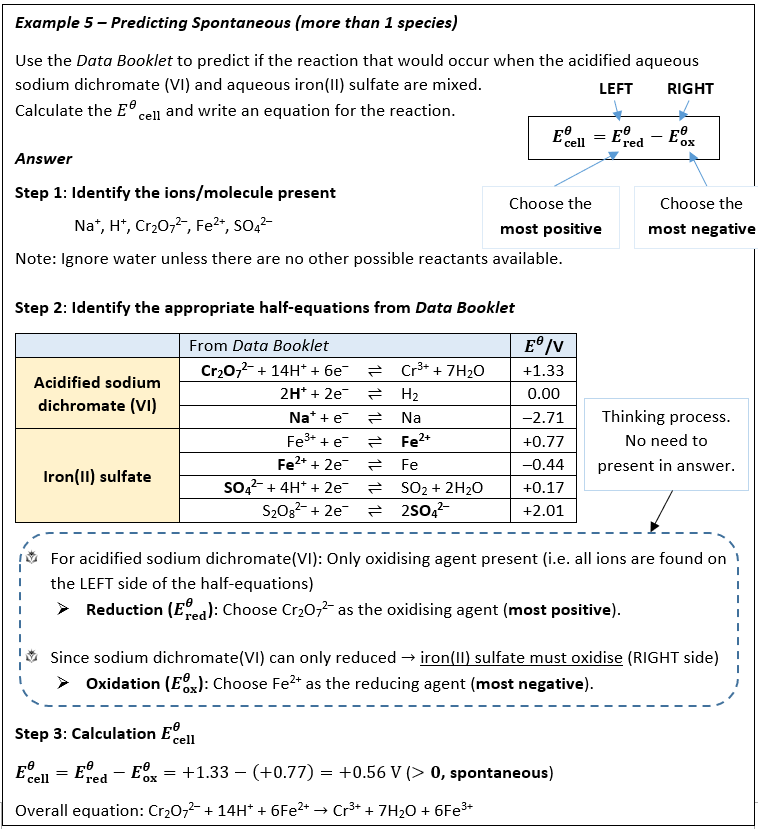
Take a look at the example below:

  • Example – In Electrochemistry, a step-by-step guide on question on predicting spontaneous reaction:
  • The Importance of H2 Chemistry Tuition for JC Students

When is it time to take a study break to avoid burnout?

It is strongly encouraged for students to practise good time management and make use of the spacing effect, which is essentially the result of learning that becomes more efficient when studying is spread over time, rather than condensed into a single session. A common practice that incorporates the spacing effect is to set goals and objectives and deciding on topics to tackle before every study session. New Dawn’s teaching method helps and guides its students by creating a study plan according to their learning pace.

Are study groups helpful?

Although forming study groups is a preferred method of studying a great many students, more often than not, students tend to get distracted and chat amongst themselves. There are also individual study pods designed for independent learning so that students are able to study at their own pace with a high level of engagement.

Which is Better? Group or Private Tuition?

Which is Better? Group or Private Tuition?

Which is Better? Group or Private Tuition?


You might be wondering whether group or private tuition is better for your child to take when it comes to certain A level subjects. At New Dawn Learning Studio, A level physics tuitionA level chemistry tuition, and A level mathematics tuition are provided. Generally, these subjects require lots of practice and, of course, basic understanding.

Group tuition refers to tuition given to a group of 3 to 15 students where the tutor will explain key concepts on a specific topic in a subject, and also encourage group work and discussion whereas  private tuition is often known as 1-to-1 coaching whereby the student gets full attention from the tutor who can teach and monitor a student’s progress on specific topics so desired.  Each type of tuition has much to offer and suits different learning needs of the students.

Here’s our take on the pros and cons of group and private tuition:

Group Tuition

Pros


  1. Healthy competition

For all three subjects: A level physics, A level chemistry, and A level mathematics, group tuition can be extremely helpful in allowing students to engage in healthy competition with their peers. This will encourage them to be more proactive and consistent in their work as they will constantly try to improve themselves to do better than those around them.


  1. Encourages group discussions

Group tuition always has the benefit of learning from peers. Many times, students have tips, on how they approach certain questions, that may be very helpful to other students who face the same difficulties they do. Group tutors have the opportunity to present questions to groups of students and allow them to brainstorm the answers. This promotes learning and lets students learn different approaches to different questions. Having a wide range of methods on hand can potentially help students tackle difficult questions, especially tricky questions phrased in a way to develop critical thinking.

Questions from other students will also allow your child to learn more than he or she would have if tutored alone, and also often prong him or her to consider other angles to a question which might otherwise be missed.


  1. Motivation from peers

Being able to study with peers can be a great source of motivation. Students may struggle in certain difficult areas in the few subjects. Knowing that ‘you are not alone’, as the students going for tuition are probably facing the similar problems, can be really comforting especially for students who are doing awfully compared to their peers in school.  Furthermore, seeing their peers being able to make progress will motivate them to adopt a positive attitude towards mastering their challenging subjects.


  1. Promotes independence

Apart from having to travel down to the tuition centres for a scheduled class, students going for group tuition may find that more of their learning depends on them taking charge. They have to speak up and ask questions when they have doubts and confide in the tutors when they have concerns, for example, in catching up.

This may seem daunting for students who are shy or not confident, but it may also help them improve their social skills in the long run.


  1. Cost effective

Apparently, the tuition fees are comparatively lower. Very often, learning centres will charge less for more subjects enrolled or more lessons taken for a subject. Hence, it is more cost effective.

Cons


  1. Distractions

Other students may talk or discuss their problems within small groups, and this may make it hard for some students to focus.


  1. Being left out

For slower learners who are afraid to speak up, they may get neglected as the tutors would be busy attending to other students with questions. Though most tutors make it a point to walk around and monitor their students’ progress, students may still find themselves lost and left out sometimes.

Private Tuition

Pros


  1. Undivided attention

Private tuition gives students the advantage of having undivided attention from their private tutors. This can benefit students who tend to face more challenges trying to grasp certain concepts or tackle application questions.

As the private tutor would be able to focus fully on one student at a time, it may be easier for the tutor to identify the weaker areas of the student and also allow for immediate clarifications and take appropriate remedial actions.


  1. Customised tutoring

Private tutors can come up with study plans that can allow students to focus on their weaker areas without the need to account for other students’ study paces. Likewise, the tutor can skip specific topics which the students are good at.


  1. Flexibility

Private tuition lets students pick the most suitable timing for themselves, which enables flexibility as they do not have to shift personal commitments to attend a group tuition with fixed schedules. Sometimes, they can rearrange their schedule to attend to other school or private affairs.


  1. Being better than before

Often, students compare themselves with their peers. This can work for certain students who use peer pressure to their advantage and engage in healthy competition. However, for some students, particularly introverts, it can be much more rewarding to monitor the progress they have made since they start private tuition. Knowing that one is improving can be satisfying and encourage students to keep going and making improvements.


  1. Time saving

Usually, students will arrange for their tutors to go to their homes which saves up much travelling time, unlike going to and fro from a learning centre.

Cons


  1. Higher cost

Undeniably, private tuition incurs higher costs as compared to group tuition.


  1. Lack of independence

As private tutors continually provide their students with all the resources they need and monitor their students very closely, students may become too reliant on their private tutors for information and it also leads to the tendency to ask the tutors for worked solutions instead of trying to think and solve the questions.


  1. Speed may not be as fast as expected

As private classes are tailored to the student’s needs, students who do their work slower might not feel the need to speed up. Group tuition, on the other hand, allows students to gauge if their speed is reasonable and work harder to catch up so they do not fall behind.


We hope that the above list of pros and cons of group and private tuition we have given for A level physicsA level chemistry, and A level mathematics, is sufficient and helpful. Now, let us move on to talk about the most important aspect to consider when deciding on the best type of tuition for your child.

As you might have guessed, the most important aspect is your child’s learning preference.

At the end of the day, your child is going to be the one attending the tuition, and thus will be the one reaping any sort of benefits from it. To make the most out of the type of tuition you choose, let the environment best suited for your child take priority.

Some questions you may consider are:

  • Does competition drive your child to do better? Or could it potentially lower their self-esteem, making it difficult to find motivation and surpass their group mates?
  • Is your child easily distracted or does he or she enjoy sharing knowledge and learning from others?
  • Does you child prefer one-on-one learning or would that be intimidating and uncomfortable for him or her? Would learning in an environment similar to a classroom allow your child to focus better?

Being put in an environment your child prefers may very well foster interest in a subject they once found a chore to learn. Furthermore, everyone has different concerns and preferences. Though it is good to have done research on the best type of tuition for your child, our ultimate advice is to put your child’s learning preferences first and let him or her decide what is best for himself or herself.

If you’d like to see if your child can thrive in New Dawn’s learning environment, feel free to contact us!