whatsapp-icon

What’s a Good Time to Start Tuition for H2 Math?

What’s a Good Time to Start Tuition for H2 Math?

What’s a Good Time to Start Tuition for H2 Math?

Students often wonder if they should sign up for H2 math tuition or if they will eventually be able to grasp the gist of their learning material on their own. While the latter isn’t impossible, it’s reasonably more challenging, and getting tuition on this subject could get you the help you need to get ahead much more quickly!

So if you’re torn between seeking for help or not, here’s what you need to know about H2 math tuition in Singapore, and when to sign up!

Differences between Secondary School Math and JC Math

Although some of the topics overlap, there are many core differences between secondary school math and JC modules. Firstly, JC math is much more in-depth than in secondary school. While the latter may teach you specific topics and methods that you will use again in JC, you’ll have an introduction to many new techniques at a faster rate.

Students often find secondary math to be more straightforward, while JC math requires learners to study and think harder. While studying math (secondary school), you’ll learn about measurements, algebra, geometry, statistics, and probability. However, once you begin H2 mathematics, you’ll learn a variety of new topics, including sequences, vectors, complex numbers, and calculus. This list is just a start—many other issues may arise during your coursework.

Secondly, when preparing for the secondary math exam, you know what to expect. The math exam only covers a brief list of topics, and the questions are more standard. If you practice and study enough, there shouldn’t be any surprises in you A math or E math exams.

On the other hand, JC maths exams will cover a variety of topics. Questions are not always as easy to understand. Students must think about every math question before they proceed, as it’s common for these topics to jump around a good deal. It’s not uncommon for students to confuse math topics. Since the math topics link in one way or another, if you do not fully understand the current module at hand, your comprehension of the next one will suffer.

Lastly, secondary school math requires less computation. Because of this, students often find these modules to be more manageable. H2 math has much more demanding computation requirements. When combined with so many new topics, you may find yourself unable to answer any questions if you know have enough knowledge and practice. That’s why JC math tuition is so helpful for students. In JC math, you do learn something new every single day.

The Risks of Starting JC Math Tuition Late

Do you need to begin H2 math tuition Singapore right away? The answer to this question indeed relies on your background and knowledge of math. If you struggled with secondary school math, then beginning tuition right away is the best choice. However, if you excelled in the previous math, you may choose to wait until you reach a topic you don’t understand.

Sometimes, students forget how to answer questions from their secondary school math. Since these topics do appear again in H2 math, early tuition is beneficial. A tutor will review previous modules to make sure you retain what you already know.

Many students make the mistake of signing up for tuition right before their exam. Even though a month may seem like enough time to practice a variety of topics, it’s not early enough. Those who join tuition later often end up doing poorly on the exam. They may not be even able to promote to JC2. Consistency is critical if you want to succeed.

Every student needs to realize that success in H2 math is all about regular practice. Even if you think you understand a topic, if you don’t answer enough practice questions, you may forget the correct techniques. Those who succeed in JC maths usually spend more time working on a variety of math questions and topics than those who do not.

When you sign up for JC math tuition, a highly experienced tutor will begin working with you right away. They know how to see your weaknesses and help you overcome any obstacles. A tutor will also help sort through the various questions to aid in your study. By the time you take the exam, you’ll have more exposure to different types of math questions than students who do not seek tuition. This one-on-one studying will ensure you are ready for any questions on the exam.

The Student’s Interest in Maths

If you were to evaluate a variety of students, you would learn that many kids are not competent in maths. Because of this, they become disinterested in the subject altogether. However, university admission often relies on not only knowledge but also interest. The JC system looks for independent thinkers, and a lot of emphases is placed on self-directed learning.

However, if a student becomes better at maths, they will gain a newfound interest in the subject. These students tend to retain information better, and the score higher on exams. H2 math tuition can help a student who is weak at math get stronger. The sooner you find a tutor, the better the results. At New Dawn Learning Studio, we offer tuition to those who may be struggling with H2 Math, or just want to strengthen their knowledge in the subject! With carefully planned study itineraries and up-to-date research on examination trends, we confidently help students master H2 Math and score in their A levels.

How I Revised For JC Math and aced my A-levels

How I Revised For JC Math and aced my A-levels

How I Revised For JC Math and aced my A-levels

Some might be puzzled over how to revise for H2 math in junior college, a subject that could be easily aced in secondary school but is now difficult to even pass. There is a paradigm shift in the level of difficulty in the questions and receiving a constant U or S could be daunting. Having spent countless hours in both the school and tuition environment, I’ve rounded up my best tips for H2 math revision that will help you ace with flying colours.

  1. Creating a set of notes

Crafting different sets of notes and organizing them can be seemingly chaotic. Notes from school and math tuition need to be combined together to effectively structure a comprehensive study journal.  Moreover, without proper management, you are highly susceptible to misplacing your notes and will eventually panic when studying for your A-level math paper.

So how did I effectively structure my notes? I created my very own 秘籍 (book of secrets in mandarin) – a compilation of every mathematical formula, computation, theory and equation. First, I would comb through all my notes from school lectures and H2 math tuition to decant out the theory required for every topic. Besides understanding the theory, I would attempt to take on the role of a teacher and explain the key elements of the theories to myself. The ability to explain the theory ensures that I have a clear and deep understanding of math concepts which are then instinctively embedded into my memory. Additionally, for vectors, I would frame out a table and list down the steps to solve for various lengths, reflected points and different equations of lines and planes. This method is particularly important for vectors as I found that the application component was repetitive as long as you could develop a clear understanding of the question.

During my math revision, this book of secrets proved its worthiness as I could easily refer to the book whenever I encountered tough questions. Hence, you should also start to compile your notes and ensure that it is structured in a way where you can review the concepts with ease.

  1. Practicing of the questions

The H2 math paper is not about how well you can regurgitate the memorized knowledge, but it is an application-based test. It is akin to cooking where anyone could memorize recipes but without practice and refinement, the food would simply of subpar standard. Through endless hours of practice, I have learnt the art of application – how to use my content knowledge to tackle questions in the fastest and shortest method possible. Moreover, this repetitious drill has enabled me to activate my knowledge by gaining familiarity and expertise with the material.

Besides attempting practice questions from school, I studied questions from my H2 math tuition and ran through past year prelim questions. Much like a machine that needs oil to function, constant practice is required to perfect one’s mathematical skills.

  1. Identifying question types

After attempting a sufficient amount of questions, you would realize that the questions become repetitive in nature other than the few challenging ones which are designed for the math protégées. Hence, we should prioritize the less-challenging questions as these standard questions are worth 70 marks and would still grant us an A grade.

After my practice sessions, I would document the type of question and the specific steps to tackle them in my 秘籍 (book of secrets in mandarin). During the exam, all I require is to identify the type of question correctly and apply the relevant concepts. This method gave me sufficient time to tackle the challenging questions and acquire those extra marks to confidently secure an A grade. Moreover, the steps to solving the questions came to me instinctively due to my extensive amounts of practice sessions. Hence, I did not need to memorize the solutions and the standard questions became a highly mechanical procedure. But of course, A-level math questions are ever-changing and you should always be prepared to apply the concepts on a case-by-case basis.

  1. Taking note of challenging questions

During your practice sessions, you are bound to come across certain challenging questions that you spent hours cracking your brain only to eventually surrender and refer to the answer sheet. I realized that it was imperative to take note of the question and challenge myself again in the future.

One such way of tracking was through the application – Notion, which allows users to create multiple files and notes including photos. Hence, all my challenging questions could be easily accessed when I wanted to review them. In addition, I found out that a majority of challenging questions came from past-year prelim questions and A Level math tuition tutorials.

Although my revision guide may not be tailor-made for everyone, I hope that it would give you some clarity to how you can structure your self-revision efficiently and effectively. All-in-all, achieving good grades for H2 math is an arduous journey which requires determination, resilience and discipline. Only if you invest sufficient time and effort, will you enjoy the fruits of your labour.

What to Do A Few Days Before the Exam

What to Do A Few Days Before the Exam

What to Do A Few Days Before the Exam

Nearing the examinations, every second needs to be effectively spent. However, with so many things you want to do but with so little time, compounded with intensifying stress, it becomes difficult to decide what to do.

Some might choose to practise more questions few days before the examinations. Though there are potential benefits to be reaped, I however feel that it is not the most effective way to utilize your time. The primary benefit of practice is to familiarize yourself with the question types and to train your speed. However, these benefits would only be significant if you have been practising frequently. Thus, spending the last few days cramming additional questions would not be of great help to you. Some might argue that solving challenging questions would be beneficial to them. However, I would argue that though one may feel a sense of satisfaction after solving such challenging questions, the likelihood of a similar question coming out is slim. hence, I feel that practising questions days before the examinations would not be helpful.

Instead of drilling on questions, I feel that flipping through you notes and tutorials would derive greater benefits. Flipping through your notes from H2 math tuition or from school would require less time to cover all the content. Moreover, you might also relearn things that you could have missed when you initially learnt the topic. Such missing content is important as they could reveal possible misconceptions that you have and could also be nitpicked by the setters. Additionally, you would also be able to revisit the definitions of certain terms and the understanding of certain concepts. With the 2019 H2 math Paper 2 focusing more on explanation and understanding, I have a strong premonition that future math exams would require us to explain more and hence revising the content would be crucial.

You might also consider flipping through your tutorials be it from school or from A Level math tuition. this would allow you to spot the mistakes that you frequently commit and make sure you do not make such mistakes again. Moreover, you should also take note of the various presentation that the markers are looking out for. For example, in graph sketching, the markers would be looking out for the shape of the graph, the various axial intercepts, the asymptotes, and the labels. The detailed requirements could be easily missed if they are not relooked at.

In addition to rereading of notes and tutorials, you might want to memorise certain formulas, which could not be easily derived on the spot and is not given in the MF26 formula sheet. For example, you may want to memorise the formula for the volume when a curve is rotated around the axes. Moreover, you could also focus on memorizing standard methods that you might easily forget. Methods such as those used to find the distance between planes, lines and dots, to find maxima and minima points etc.

When it’s hours before the exam, some might choose to rest with the rationale that they want a fresh head when they enter the exam hall. I, however, am an advocate of “warming the head up”. That is to avoid feeling lethargic and sluggish before the start of the exam, especially if the paper is in the morning. As a result, not every minute within the exam hall is spent at your optimal performance level. For warm ups, I propose doing a simple set of questions that are not too tough, this could come from your JC math tuition or from your school tutorials. This would activate your brain when you step into the examination hall, allowing you to quickly tackle those first few easy questions and buy more time for the tough ones later on.

H2 Mathematics Difficulties and How to Tackle Them

H2 Mathematics Difficulties and How to Tackle Them

H2 Mathematics Difficulties and How to Tackle Them

Mathematics prior to junior college to most is likely to be a breeze. However, H2 mathematics would have a sudden spike in difficulty that might initially seem impossible to tackle. Most would actually underperform in the first common test, an experience that serves as a testament to how challenging H2 mathematics can be. But fret not, you are not alone and there are ways to tackle these challenges.

The first challenge is speed. It’s common to hear students complain about being unable to complete the questions within the given duration. Common problems include being stuck on a question for a long time and thus unable to complete the easier questions at the back. Often, these questions are the generally harder pure mathematics questions, and hence, many would miss out on the slightly easier statistics questions at the back when it comes to the paper 2.
To resolve time management issues, one should first learn how to “let go”. However tempting it may be to persevere till you find a solution, this is time consuming and you would incur the opportunity cost of marks that could have been possibly gained if you had tackled the easier questions at the back.

After going through many examinations and gathering my experience from A level Math tuition, my strategy when it comes to tough questions would be to move on if my first attempt at solving them is a failure. You could also set a time limit such that you have to move on if the time is up.

Practice makes perfect. You can get practice questions from the past prelim papers as well as from H2 math tuition. Practising allows you to familiarize yourself with the common question types, giving you a general sense of what the question wants and common methods to tackle it. This would reduce the amount of time that you spend thinking in the exam hall. After much practice, you would be trained to immediately think of the steps of arriving at the answer upon reading the question.

Strategize to your strengths. You would rather spend the limited exam time on questions that you are likely to score compared to questions that stump you. To get the optimal result, you might also want to choose to attempt the topics that you are good at first and secure those marks and then move on to tackle the more unfamiliar topics. Some school tutors might advise their students to finish the statistics questions in Paper 2 first before attempting the pure mathematics ones as the statistics portion is usually easier. In New Dawn Learning Studio’s H2 mathematics tuition classes, students will be advised on exam planning too.

Another challenge would be troubleshooting. This occurs when you know that your answer is clearly wrong, but you have no clue as to where you have made the mistake. Troubleshooting is often time-consuming and more often than not, the error is a result of a small mistake such as a wrong sign or wrong number.

To troubleshoot more effectively, you can try reading through your answer once to find the mistake. if you could not find the mistake after meticulous scanning, you might want to attempt to redo the steps carefully, justifying each step you make with sound mathematical principals. This would allow you to restart afresh and avoid making that mistake again. You might also want to try other methods to solve the question. This is because the original method could have inherent flaws in it. It might not seem obvious to you, but you would not be able to reach the answer as a result. Careless mistakes are also commonly faced problems. As examinees go into a frenzy, they might accidentally skip some questions, miss some number and commit some errors. Moreover, you could misread your own writing and write other numbers or symbols in the preceding steps

Use the graphic calculator to your advantage. Though there is no algebraic manipulation software on it, you could substitute values into your answers to check. This would be useful for summation, integration techniques and differentiation type of questions where the functions could be found in “mode”. Moreover, to find the final answer, certain questions may allow you to use the GC to solve rather than having you manipulate the equation. Examples include simultaneous equations, solving for roots etc.

As the questions are often applied to real-life scenarios, ask yourself if the answers make sense and return to check your working if it does not. In statistics the data given might be obviously siding towards one of the hypotheses, then the p-value should confirm that hence a far deviating p-value should prompt you to check your answers. Moreover, practices from school and H2 math tuition should also give u a sense of what the answer range should be and you’ll make it a habit to check the answers that deviate.

Some may find memorising formulas a difficulty. Formulas like volume finding in integration technique, AP- GP formulas, integration technique formulas., etc, are easily forgettable. Coupled with stress in the exam hall, recalling these formulas is no easy task. Rather than memorising, try to understand the formulas fully such that even if you were to forget the formulas, you could derive them on the spot and not be stuck. Constant practice and getting the right guidance would make your encounters with these formulas more frequent such that recalling them becomes second nature to you.

What to Do 6 months before the A levels?

What to Do 6 months before the A levels?

What to Do 6 months before the A levels?

It is May now. At this point in time, you should have completed all the content in junior college and have taken 2 more major examinations before the A Level exams. You might have also stepped down from your co-curricular activities and there is more time freed up for your studies, especially during the June holidays. With a paradigm shift in your timetable, it could start to get chaotic and pressure would slowly build up as you find yourself spending more time studying. In this article we give some tips on what you can do before you head for the A levels.

Firstly, come up with a timetable as to how you would spend our time. With a sudden change in your schedule where you are no longer committing your time to CCA and other activities, you’re more likely to procrastinate and waste your time. Moreover, you’re more likely to be able to allocate sufficient time to revise for each subject and spend more time on subjects that you are weak in. But remember to allocate time for rest and for family time to, as you would not want to burn out before the A Levels. Ultimately, life is not only about grades and hence you should not sacrifice family relationship and friendship for academics.

Secondly, you should start to consolidate your learning. Since you are likely to have completed or nearly completed the syllabus by this point, you would have a lot of content and notes, be it from school or from A Level Math tuition for example.

It would be difficult for you to remember so much information when it is all over the place. You might want to try drawing mind maps or summary sheets which compact all the information into a few sheets of paper, allowing you to easily refer to content when you need to. This is especially useful for revision before the exams and you can even have a quick read through just before you enter the exam hall.

Thirdly, you should start to practise questions, especially for math, physics, economics and general paper, I have found practising the questions extremely useful. This is because the A Levels test your application of the knowledge in these papers instead of the simple regurgitation of the knowledge. Your school would have given you some revision packages, and if you have signed up for A Level math/ A Level physics tuition classes, you would have also received sufficient questions for you to practice. You could start on those and start to familiarise yourself with the question types and hone the skill to apply your knowledge to different questions.

Lastly, if you are weak in any subjects and think you need tuition, you should start to sign up immediately. Don’t see tuition classes as a silver bullet, as it requires time for the tutor to teach you and for you to learn. Going for tuition one month before the A Levels exams will arguably have small returns even though I am sure both the tutor and student try their best. Start to look for a good tuition class early so that you could start to build your content knowledge and skills as soon as possible, allowing you to more easily overcome the upcoming examinations and A Levels.

6 months might seem like a long time, but you would have to spend it wisely if not you would regret when you take the a levels. Start a timetable, consolidate your knowledge and start practicing questions. If you have to, sign up for jc math, physics or chem tuition and receive the aid you need before its too late.

Should I drop from H2 Mathematics to H1 Mathematics?

Should I drop from H2 Mathematics to H1 Mathematics?
Should I drop from H2 Mathematics to H1 Mathematics?Upon receiving your recent H2 Mathematics examination results, you may be disappointed that you have failed or barely passed it even though you have worked hard to prepare for the examination. Now, you may be wondering: Should I drop from H2 Mathematics to H1? To help you make a better-informed decision, here is a list of things that you should consider.
Before reading on, it is important that you know the clear differences between the content of H2 Maths and the H1 Maths syllabus. Knowing the differences can give you a good idea on what to expect out of your lessons and examinations. You can read more about it in our previous blog post here

3 Things To Do Before Dropping your H2 Mathematics

a. Check the subject prerequisites for your desired University course.

Dropping from H2 Mathematics to H1 will inevitably limit the university courses that you can apply for, as many of them require a minimum pass in H2 Mathematics. From the moment that you drop your H2 Mathematics to an H1, you have closed all doors to courses such as Medicine, Dentistry, Engineering and more.

However, fret not, there are still other courses such as Business, Arts and Social Sciences that only require a pass in H1 mathematics. Thus, to ensure that your H1 Mathematics do not put you in a disadvantaged situation, always check the subject prerequisites properly.

b. Know the pros and cons of H1 Mathematics.

Knowing the advantages and disadvantages of dropping to H1 Mathematics can help you make a more informed decision. An obvious advantage of taking H1 Mathematics is that it is a lot less rigorous than H2 Mathematics. Why? This is because for H1 Maths, many of its topics have already been explored in secondary school.

This is especially beneficial for students who have taken A maths before as H1 Mathematics topics such as exponential and logarithmic functions, basic differentiation and integration would have already been familiar to them. The only new topics in H1 Mathematics will be statistics, which takes up 40% of the final score.

Questions in H1 Mathematics Paper are known to be more direct and straightforward. This is unlike the H2 Mathematics Paper, which usually contains higher-order thinking questions that cannot be solved by the mere regurgitation of mathematical formulae, but require a deeper understanding of the mathematical concept.

Additionally, with less content to cover for H1 Mathematics, you now have fewer lectures and tutorials to attend. Your learning pace is relaxed, and you may find H1 maths to be more manageable, requiring less time and energy from you. Thus, the time that you spent previously cracking your brain over tricky H2 maths questions can now be saved and devoted to improving your other H2 subjects.

However, as previously mentioned, the downside to taking H1 Mathematics would be that your selection for University courses will be largely limited. It may be ideal to keep your H2 Mathematics if you are still unsure of what courses you are interested in, and want to keep your opportunities opened.

c. Seek advice from your seniors.

Your seniors are actually one of the best resources that you can tap into. As the school tends to provide the same lecture materials and the school curriculum is usually unchanged, your seniors’ studying experience can be largely similar to yours.

Hence, ask them for advice on whether dropping to H1 Mathematics had been beneficial or whether they were able to cope with the high demands of H2 Mathematics. Who knows? Your seniors may just be able to provide you with fresh insights and even a tip or two!

Ultimately, this is not to say that the journey of studying H1 Mathematics will for sure be a smooth sailing one, but there are definitely fewer obstacles that an H1 Maths JC student must overcome, as compared to an H2 Maths student. (Especially if Maths have always been your weakness since secondary school, letting go may be the best thing to do!)

Coping with H2 Mathematics

However, if you wish to hold onto H2 Mathematics despite struggling with it, it is advised that you seek H2 Maths tuition classes as early as possible! This is to ensure that you have sufficient time to dispel any existing misconceptions and to build on your Maths foundation. It is important that you find that H2 Maths tuition can provide you with the additional guidance and practices that you will need to improve your grades.

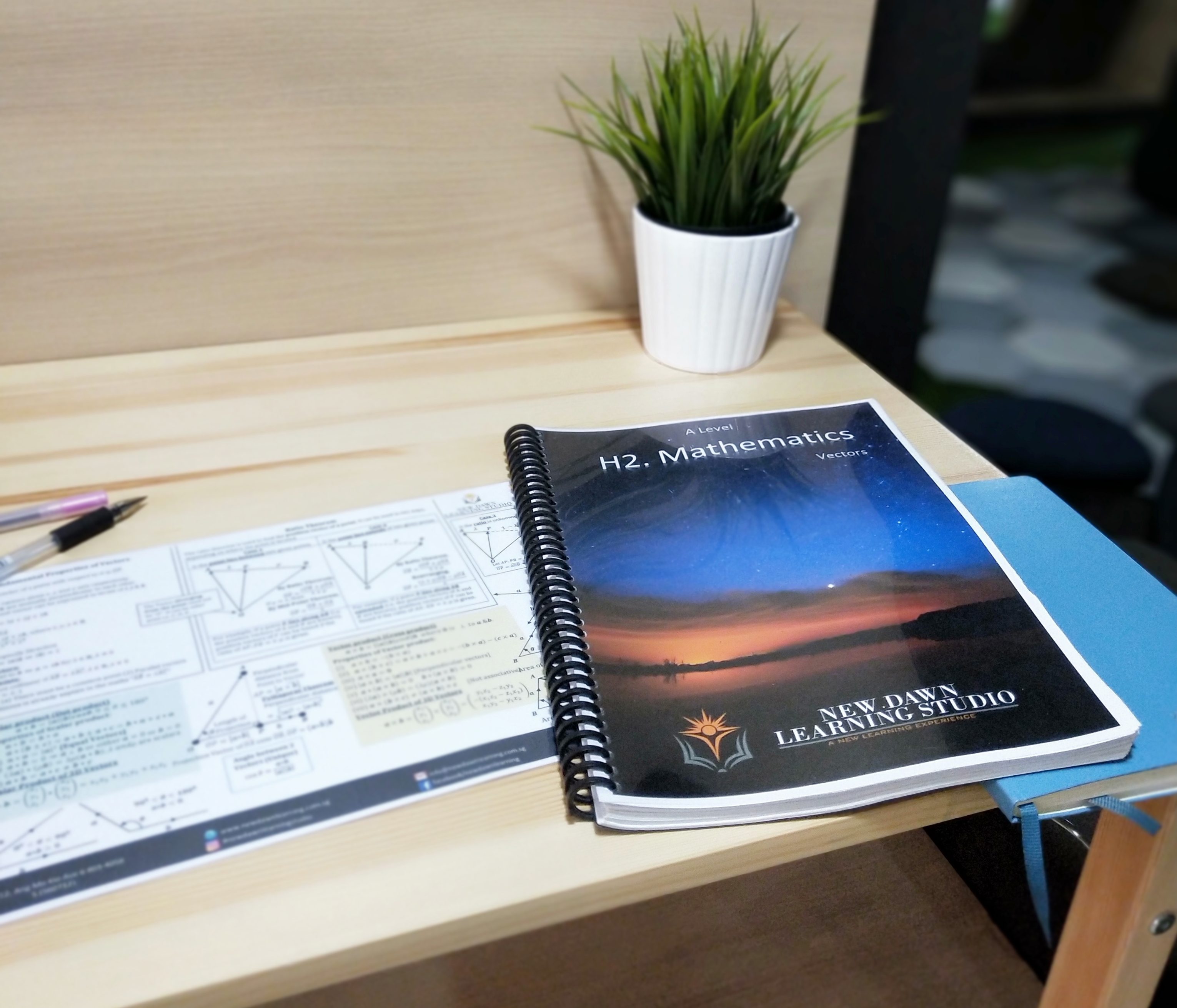
At New Dawn Learning, we provide ample practices that can expose you to the various question types in examinations. Besides, to strengthen your understanding, we provide comprehensive notes and quick sheets that are helpful for your revision.

Academic challenges in Junior College vs Secondary Schools

Academic challenges in Junior College vs Secondary Schools

Academic challenges in Junior College vs Secondary Schools

As one ends his or her O level journey, one might wonder what the difference is between junior college mathematics and secondary school mathematics. I hope to shed light through this article about the differences between junior college and secondary school that might help you to make a better decision when choosing your subject combination after secondary school.

Junior college is very similar to university in a way that JC students are taught in lectures and tutorials rather than being limited to the usual classroom settings where a teacher is allocated to each class. Lectures would teach students the content and the tutorial would tackle questions that are assigned to the students.

  1. Lectures

In a lecture, a single lecturer engages the entire class and teaches to many students at one go. Especially for popular subjects such as H2 mathematics or H2 chemistry, there would be many classes sitting in the lecture hall and the session would be less interactive. Knowledge would only be transferred in one direction—from the lecturer to the students. The less engaging the lecturer is, the more people would dose off. Moreover, once you miss an important part of the lecture, you would be easily lost and would become disengaged from that point. Though lectures are recorded, you might not want to re-watch the lecture given that time is really of the essence especially when the A levels are nearing.

My tips to surviving Math lectures:

  1. Read up before the lecture and do the example questions for mathematics if possible. This would allow you to catch up with the lecturer and not feel lost when the lecture introduces new content. Moreover, you would know what to listen out for when the lecture is given so instead of being overwhelmed by the new content, you would be picking the information you need to fill your gaps in understanding.
  2. Make notes by the side to keep your brain active. More often than not, just listening to the lecturer would not allow content to be effectively absorbed and registered in the brain. By taking notes, it would allow you to record your train of thoughts and important tips that the lecturer might give. In addition, it could stimulate your brain to think more deeply about the content, allowing a better understanding of the subject.
  3. Attend A Level math tuition classes. Honestly, if you were unable to keep up with the content and are more used to the secondary school way of teaching, tuition classes could help you to better grasp the subject. This should be done as soon as you realise that you cannot keep up, so that you would not lag behind too far.


  1. Time management

Previously in secondary school, you would be taking around 8-10 subjects, and you can constantly toggle between subjects when revising to ensure that some time is allocated to each subject. Now, the game changes on the junior college level where you are only required to take 5 core subjects, excluding Project work, but the caveat is that each question requires a significantly greater amount of time.  In secondary school, a math question can be completed within 5 minutes or so, however, in junior college it would require 15-20mins, especially during the initial stage when you still do not have a good grasp of the subject. Time becomes tight before major examinations, and thus you would really want to optimize your time and reap the most benefits from each hour of revision, with the opportunity cost being significantly high.

JC Math tuition classes could help you with this, where materials are carefully curated so that you do not have to spend time and effort on revision that reap little gains. Moreover, the summary sheets and notes that they could offer would help reduce the amount of time needed to revise the topics, buying up more time for practice questions.

  1. Lecture Notes

Textbooks would be almost non-existent in junior college. Instead there will be lecture notes that the teachers created. As lecture notes are uniquely curated by each junior college, it is common that the lecture notes might be lacking something in one school, or simply contain too much information as compared to the other schools. Furthermore, the notes may sometimes be hard to digest, and you could spend hours wrecking your brains trying to comprehend them.

Writing out your own summary would help condense the information from the lengthy notes so you’ll be able to revise more efficiently nearing the A level examinations. In addition, you should clarify any doubts that you have with your tutors when you have problems understanding the notes. You could also try to attend JC math, chemistry or physics tuition classes, which would also provide notes that could possibly be more comprehensive and are easier to understand. Moreover, if you are afraid to ask your tutors in school, tutors at JC tuition centers like New Dawn Learning Studio are very friendly and approachable should you want to clarify your doubts with them.

Taking the junior college route would be a very fast paced 2 years of your life. Though it could be challenging at times, there are always ways to tackle obstacles along the way. While JC tuition classes may help you tackle this insurmountable challenge, it would too require your own effort to survive junior college.

Differences between Further Math and H2 Mathematics

Differences between Further Math and H2 Mathematics

Differences between Further Math and H2 Mathematics

After taking further mathematics for 2 years and looking back, I don’t regret my seemingly rash decision during matriculation when I chose to take up the subject. Hence through this article, I hope to shed some light on further mathematics as a subject and give some advice to JC students who plan to take it.

  1. Content

There are a few further mathematics topics that build on the H2 math topics that would teach us more depth into those topics. For example, JC students who take H2 math would only learn integration application limited to the scope of area and finding volume using disc method. However, in further mathematics, you would be taught how to find the volume using shell method, and how to find length of arc and surface area of a rotated curve. Moreover, the integration would not be limited to cartesian and parametric forms but would include polar forms as well.

In addition to building onto topics, there are also additional topics within further mathematics, such as linear algebra which initially teaches the use of matrices and then moves on to linear spaces followed by eigenvalues and eigenvectors, which is taught in 1st year university math courses. However, some of these new topics like linear algebra could be very abstract and maybe difficult to grasp initially which might cause some to struggle.

  1. Teaching style

JC students who take up further mathematics are spared from the large lectures that students who take H2 Mathematics have to attend. Instead the lecture group is usually the class itself, which also means that there are more interactions with the lecturers. Its more akin to a math lesson in secondary school where question could be asked during the lecture as oppose to one sided teaching whereby the students merely engage passively in class. 

  1. Teaching pace

As further mathematics is built on H2 mathematics, you could expect to complete the H2 syllabus before your peers that opted for H2 mathematics (I completed mine at the start of J2). In a week, there would be 2 topics that are taught at the same time, usually taught in an alternating fashion. This applies to tutorials as well.

You would be required to complete tutorials and assignments as quickly as possible and try to keep to the deadlines as it would be difficult to catch up if you lag behind. You are also expected to read up and try the example questions within the lecture notes so that you won’t be lost during lectures.

My suggestion would be study during the holidays. Other than the March, June and September holidays that are used to revise for the examinations that come after them, the December holidays should be used to study as well. Either revise on the topics that you are weak at or start reading up on the next few topics so that when school reopens, it would be easier to catch up.

It is common knowledge that the pace that mathematics is taught is very fast and you need to be adept enough to switch between different topics as different topics are taught together. If you find your H2 math being weak, you should immediately seek help as soon as possible. This is where H2 Mathematics tuition could help you to strengthen your foundation and the weekly practices at New Dawn Learning Studio ensure that you never lose touch of H2 mathematics techniques.

  1. Learning style

Other than different lecture styles, the way JC math is being taught differs vastly between junior colleges in Singapore. Instead of making it an individual effort where it is only you against the questions, my junior college encourages discussions. It is no longer only about getting the answer, but also whether there is a more elegant and succinct solution, whether there are cases that one would fail to think about and whether the presentation is clear. All these require your peers’ eyes and thoughts as well, and you too will learn from them and improve yourself.

Generally, JC math teachers and tutors are very passionate about the subject. You could expect to pick up additional information that are not within the syllabus that the teachers feel could be useful in tackling questions in A Levels as well.

For example, I was taught the De Morgan’s law, which is extremely useful in tackling probability questions in H2 math as well. Your peers too will be very passionate and you could pick up some additional information from them. The level of passion for elegant and beautiful math is what differentiates a H2 mathematics class from other mathematic subjects across all levels. So if you love math as much as I do, then New Dawn Learning Studio provides the perfect learning environment for you.

I am sure that anyone that loves math would enjoy such an environment.

Tackling H2 Mathematics Vectors

Tackling H2 Mathematics Vectors
Tackling H2 Mathematics VectorsVectors could be daunting and is arguably the most difficult topic in H2 mathematics. Many JC students struggled with it, some survived while others perish when it comes to vectors questions. Here, we offer some tips to better tackle this topic and show how H2 math tuition classes might help.

There are generally 2 types of math questions under the topic of vectors. One is the dot and cross problem, which I feel is more of an algebraic manipulation practice. The other would be the application type of math questions where you need to find distances, length of projections, etc., given the context. It is important to differentiate these two types as the method to tackle them is very different.

a. Dot and Cross Problems:

It is important to understand the key concepts in dot and cross products. One of the crucial concepts you should take note of, is that cross products create a vector that is mutually perpendicular to the 2 vectors that you have crossed.

Try to not to expand everything as it would make the expression messy and the pattern difficult to identify. Rather, try to factorise the expression and group like terms together. Doing so makes it easier to identify a pattern.

“Force out the result” after knowing your end goal. At least you would have a general direction as to how you should add or eliminate terms and move closer to the result as opposed to doing mindless manipulation that could bring you further away from the answer. Moreover, during the actual A levels H2 mathematics exam, it is more likely that you would gain the method marks along the way even if you do not arrive at the correct answer.

b. Application Type Questions:

Sketch out the scenario that is being presented in the math question if the questions have no diagram for you. it could be difficult to picture the situation when so much information is presented to you at one go. It would also be easier to retrieve information when you annotate on your diagram and consolidate all the information in one picture. Moreover, you should look at the image from different angles, and draw out the one that could capture as much information as possible or the one that would allow you to clearly see a relationship between the dots, lines and planes. This would make it easier for you to think of methods to answer the question when the relationships are made clear.

It’d be helpful to create a summary for the different methods. There is a certain set of skills required in vector application like finding distance between a point and a plane, distance between planes etc. the same methods could be employed across different questions, so consolidating them would make it easier for you such that when you identify a question that requires a certain skill, you could immediately employ it, saving you precious time during the H2 mathematics exam.

Identifying which skills to use may not be easy. Constant practice of common math question is required so that you could identify the skills required immediately. H2 math tuition could help here to offer you more exposure to the different questions, and also help you sort questions easily according to the different skills that are required.

Most importantly, to tackle vectors effectively, you should have a good grasp of the subject. If you feel that you are lagging behind, you may want to consider signing up for A Level math tuition with us at New Dawn Learning Studio, where more attention could be given to you to help you bridge the gaps in understanding. Moreover, our easily comprehensible notes would allow you to more easily grasp the concepts.