whatsapp-icon

Preparing for A Level H2 Chemistry in 2021

Preparing for A Level H2 Chemistry in 2021
Preparing for A Level H2 Chemistry in 2021H2 Chemistry is easily one of the tougher subjects that plenty of Singaporean youths struggle to cope with as they transition to higher education. And there is a good reason for that! The A Level syllabus for H2 Chemistry delves into significantly more details in understanding and application of chemistry concepts, focuses on more technical calculations and illustrations, and covers a wider number of topics compared to what your child may have prepared for their O Levels.
Sounds challenging? Not to worry. While it is a daunting subject, it is still definitely within your means to help them succeed in the subject with the right approach and preparations in the upcoming year.
Read on to learn more!The Difference Between Secondary School Chemistry & A Level H2 Chemistry
To help you fully understand the challenge ahead, here is a simple summarized breakdown of the key differences between what was taught for the O’ Levels and what will be expected for A’ Levels

O’ Level Chemistry

A Level Chemistry

11 topics from Experimental Chemistry to Organic Chemistry – basic understanding. More than 20 topics across 3 main aspects

  • Physical Chemistry (e.g. Mole calculations & Redox, Chemical bonding)

  • Inorganic chemistry (e.g. Periodicity & Transition elements)

  • Organic Chemistry (e.g. Alkanes, Alkenes, and Carboxylic Acids and Derivatives)

Understanding of chemistry principles, concepts, and basic problem-solving skills. Greater emphasis on both understanding as well as the application of higher-order thinking skills which require integrated understanding across multiple topics.

As can be seen from the table above, it is clear there is a leap in terms of learning outcomes and expectations – and that is what many students struggle with. And this is especially so if their foundation in secondary level Chemistry is weak, to begin with.

So how can you help your child to prepare for their H2 Chemistry A’ Levels in advance?


How to Prepare for H2 Chemistry Exam: Structured Learning & Practice Tips

Here are some useful tips and preparation methods that have worked well for many of our JC students who have aced their Chemistry papers:


Get Your Fundamentals Right

With more than 20 topics to master in 2 years, it is absolutely critical to ensure your child understands each topic as it is taught so they would not struggle to play catch up.

However, with mostly lecture-based teaching in schools, which does not accommodate targeted attention, many JC students find it tough to thoroughly digest and comprehend topics as they are being taught. This problem is exacerbated in the second year, where new topics continue to build on from what was taught in the first year. With a shaky foundation, learning in the second year can only get more stressful.

To counter this problem, at New Dawn Learning Studio, we offer A Level chemistry tuition in group tuition settings that help our students get their fundamentals right from the start by:

  • Providing specially curated guided notes and summary sheets for focused learning

  • Step by step guidance to help build strong fundamentals

  • Exam focused practice questions to prepare them for the rigor of examinations

  • In-depth analysis of practice papers and preparation for the A ‘levels with the expert guidance of a tutor who’s a contributor to the Ten-Year Series guides.

  • Encouraging problem-solving with fellow peers

  • And more…


Practice Tips That Helped Our Students Ace Their H2 Chemistry with Flying Colours:

Want to help your kid to do well for their final exams? Here are some useful tips based on our students’ experiences!


Revise Regularly

This is especially the case for a content-heavy topic like Chemistry. Revising helps students reinforce their understanding of each topic – and that is essential when the new topics build on the understanding of the previous ones.

This is where our specially curated notes come in handy! With all the key concepts broken down simply, and practice questions to help maximize learning efforts, going through the notes is enough revision in itself! No need to reference multiple textbooks or assessment guides – just review our detailed step-by-step notes to revise efficiently!

Check out an example of our H2 Chemistry Notes

Need more structured revision help? Or lagging in school? We also offer quarterly workshops in March, June, September, and December to help students who need even more structured and guided help for specific topics!


Ask to Clarify

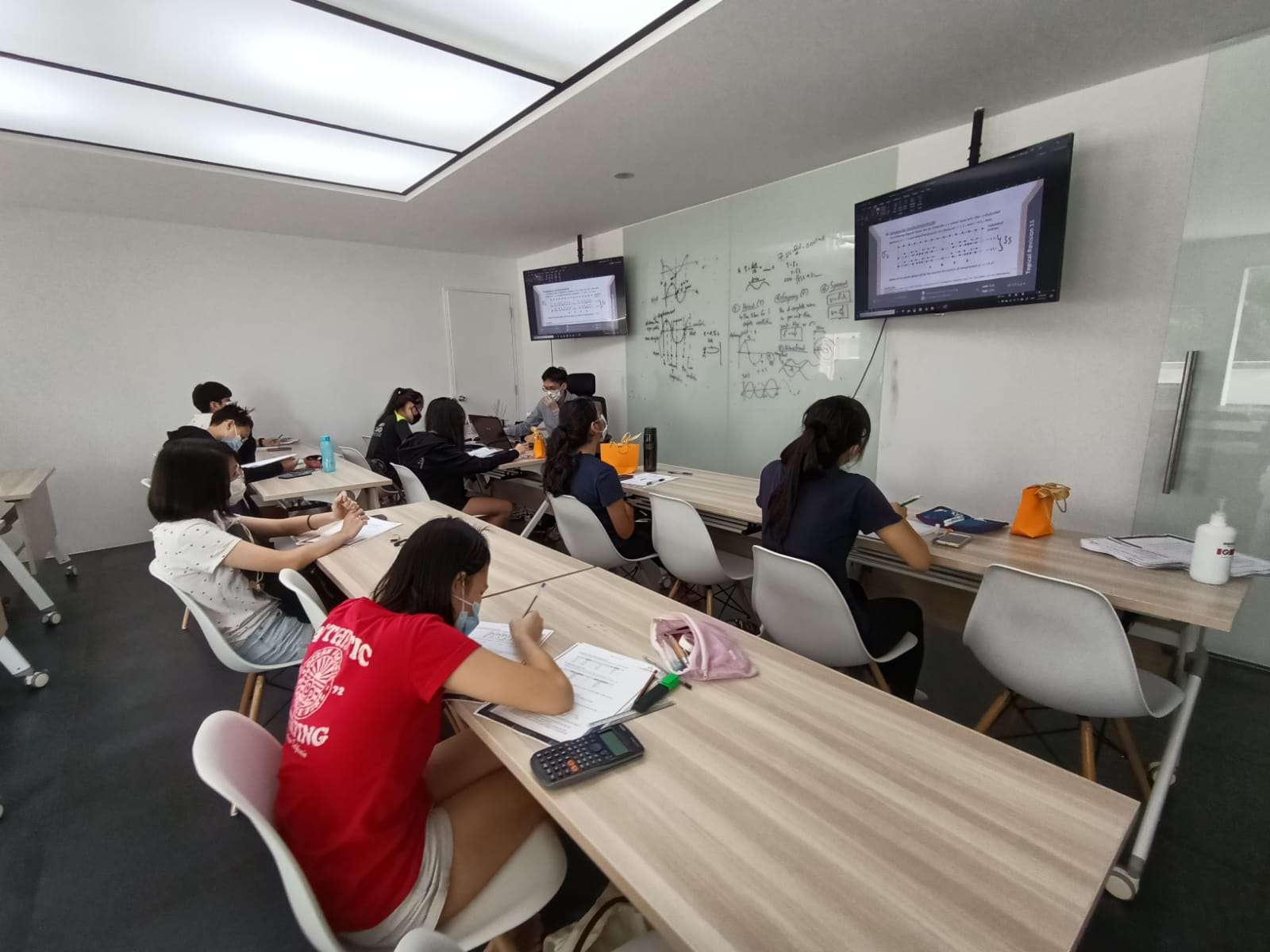
Unsure of anything? Make sure to ask and clarify! At New Dawn Learning Studio, we create a conducive learning environment that encourages our students to check-in and clarify their understanding during each session with them.

In our tutorial settings, students are more comfortable raising questions, discussing problems amongst themselves, and more. This higher level of engagement in turn helps students better grasp the concepts at their own pace.


Practise Exam Questions

There are two components to acing an exam and both are essential.

1) Comprehensive understanding of the subject

2) Effective examination techniques

Apart from ensuring our students have a sound understanding of Chemistry principles, we make sure to help them approach examination questions in the most efficient and effective ways. In our regular tutorial sessions, close-to-exam revision classes, or quarterly workshops, we go through step by step methods of approaching practices questions and exam papers from a variety of top schools.

With regular practice, our students get the hang of the right way to approach examination questions and are a lot more confident when facing the actual paper.


Need A H2 Chemistry Tutor for Your Child?

Start 2021 right! H2 Chemistry tuition can help give your child the head start that he or she needs in a new learning environment. Do not wait until they start struggling in Year 2!

At New Dawn Learning Studio, our speciality is in Math, Physics & Chemistry Tuition. Our specialized H2 Chemistry tutor, Mr. Joseph Lee, is also the invited author of GCE A ‘Level H2 Chemistry Ten Years Series (both topical & yearly editions), with a fantastic track record and glowing testimonials from his students.

Interested to learn more about our H2 Chemistry tuition? Simply drop us a message to let us know how can help your child in their learning journey.

Choosing The “Right” H2 Math Tutor: What to Look Out For?

Choosing The “Right” H2 Math Tutor: What to Look Out For?

Choosing The “Right” H2 Math Tutor: What to Look Out For?

Is your child finding the syllabus for JC math a lot harder to manage than secondary school? Want to prepare your child for the challenges they may face in A Level’s H2 Math but unable to teach them yourself? The next logical step for most Singaporean parents would be to find a qualified math tutor to fill the gap.

But how do you choose the “right” math tutor for the job? With hundreds of tuition centres and freelance private tutors to choose from, it can be a mind-boggling endeavour for anyone.

Need some tips on what you should look out for? Here are 4 key factors any parent should consider:

10,000 hours is the magic number of greatness” And that is the reason why subject experts are always better at what they do than a generalist.

Compared to a tuition teacher who teaches multiple subjects and specializes in none, a specialized subject tutor would most definitely produce much better results for the following reasons:

  • Understanding of the subject and syllabus in detail
  • Experience in explaining concepts and exam techniques in the most effective way
  • Fine-tuned teaching materials adapted to students’ needs over the years
  • Good Track Record & Testimonials

How do you tell if your child will be in good hands? In this case, a simple “Google search” can tell you plenty:

  • Track Record: How long has the tutor been teaching H2 Math tuition? How many students have they taught? What are the success rates?
  • Student Testimonials: Students who enjoy their learning experiences are typically happy to share their personal experiences online.
  • Parent Testimonials: Speak to fellow parents to learn more or ask for testimonials from the tutor.
  • Effective Teaching Methods and Teaching Materials

Mathematics can be a dry and tough subject if taught by the wrong teacher or with ineffective teaching methods or materials– and that is especially the case for JC-level math which gets only more complex.

This is where effective teaching methods come into play – these may vary from centre to centre and between tutors:

  • Small-Group Lectures: Well-structured, engaging lectures and complementary notes are critical to helping students breakdown and understand difficult and challenging topics.
  • Tutorials: In-class practices in the form of a variety of tailored practice questions, quizzes and more are important in helping students review, revise, and clarify concepts that they have just learnt.
  • Self-Practice: Math is all about practice – hence self-practice worksheets and exam papers are essential in helping students reinforce their learning outside of class too.
  • Summary Sheets: Consolidated formula sheets come in handy as quick references for students going through quick revisions for their examinations.
  • Exam Oriented Math Camps and Workshops: Usually conducted during the March, June holidays and before exams, these “boot-camp” styled camps, and workshops can help students get a crash course on the topics.

Depending on your child’s learning style, it would be best to find a tutor that provides a teaching method that matches their needs – which ties into the next point.

  • Trial Session

Apart from online research and in-person visits, it would be best to get your child to sit in for a trial session if possible!

Online research can only tell you so much. An in-person trial session is the fastest and probably most effective way of determining if the tutor is a good fit.

A quick trial class would be able to help your child and you assess:

  • Is the learning environment conducive and comfortable for them?
  • Is the tutor teaching in an engaging manner?
  • Is the tutor using customized in-house materials?
  • And other possible concerns…

How to Choose The “Right” H2 Math Tutor for Your Child?

Based on these criteria, it would be best to start by shortlisting a few tutors or centres with the right qualifications and call up to learn more about their teaching approach.

At New Dawn Learning Studio, we specialize in Math, Physics & Chemistry Tuition. Our specialized H2 Math tutor, Mr. Daniel Yeo, is also the invited author for GCE A ‘Level H2 Mathematics & H1 Mathematics Ten Years Series, with a great track record and glowing testimonials from his students.

Interested to learn more about our H2 math tuition? Simply drop us a message to share with us any specific learning concerns you may have for your child.

Last 30 days to A level preparation for H2 math

Last 30 days to A level preparation for H2 math

Last 30 days to A level preparation for H2 math

How to Spend the last 30 days of A Level Preparation for H2 Math

Walking pass the foyer, looking at the number on the board counting down to the exam date never seems to get easier with each subsequent day. Though my A level days are long past, I still remember those days fondly for the moral support and advice given to me by my peers and tutors. I would thus like to share some tips on how to tackle A level mathematics from a student’s perspective.

Patch Up Holes in Understanding

Firstly, you would need a strong understanding of the topics in H2 math before you could apply your concepts. I feel that it would be good to revise the notes on the topics that you are weak at to patch up the holes in your understanding. Not only should you read the notes, you should also annotate at the side. If you have the time, you could also write out a summary which could be used for revision just before the examination. This encourages critical thinking instead of blindly rereading or copying the notes, and this would hopefully help you to better understand the concepts. As the examination tests you on the application of concepts, you should also practise some questions on that topic by using the topical ten-year series for H2 mathematics or by practicing A level math tuition question sets. This would familiarise you with the different question types that Cambridge sets and ideally allow you to better tackle them on the day of the examination.

Review Past Careless Mistakes

Secondly, reviewing the work you have done would help you improve as well. I believe that the mistakes that you have made are the best places for you to learn. These mistakes could have been made due to unfamiliarity of the method being used, so you might want to relook them again. Moreover, by reviewing your mistakes, you might be able to spot habitual careless mistakes. If so, you might want to be more meticulous in your work and check for similar carelessness during the examination. How I would go about reviewing my mistakes is by reviewing my tutorial sets as well as my JC math tuition questions to jot down the numerous past mistakes I have made on a post-it note as I flip through the pages. Not only do I note the mistakes down, I would also indicate how I would prevent such mistakes in the future and the things to take note of.

Familiarise Yourself with the New Statistics Questions

Thirdly, I would reread my statistics notes to recall the theory again. In my year, statistics questions took a turn from mostly calculations to more explanatory questions. For instance, one question asked how a random sample should be selected. These explanations are often forgotten as we are more familiar with the questions that require more calculations. It would be good to familiarise yourself with the new exam requirements again so that should Cambridge set similar questions this year, you would be prepared to tackle them.

Timing is Key

Lastly, practise the past year papers under timed conditions. Students often find that they do not have sufficient time to finish the paper or are so pressured by the time that they cannot think straight. By practising under timed conditions, you condition yourself to think quickly and immediately zoom into the most important parts of the questions during the examination. Having practised under the pressure of time, you would also be reassured on the day of the examination that you could finish the paper and would hopefully feel less stressed on the day itself. Hopefully, this would give you clarity of the mind to better focus on the questions.

To summarise the above points, during these last few days before the examination, other than touching up on the topics that you are unfamiliar with, you can also review your past mistakes so that you would not commit them again. I would also advocate to reread the statistics portion to better understand the theory behind the methods rather than pure memorisation of the methods. Last but not least, you should also practise past year papers under timed condition to train your speed and give yourself reassurance during the examination. I hope this advice from an ex-student’s perspective would help you in your preparation for the examination.

All the best!

H3 vs H2

H3 vs H2

H3 vs H2

The Difference between H2 and H3 Physics

The H3 syllabus is meant to build on and further the concepts, skills and understandings in A Level H2 subjects. H3 may seem daunting to those who plan to take it but looking back on my H3 journey, I am grateful for it. Having taken H3 in physics at NUS, let me share with you the differences between H3 and H2 physics for those who are considering taking up H3.

To give some background to my course, my H3 physics classes were taught in NUS by their professors and we attended lectures and tutorials with the NUS students. We had two lectures a week, one tutorial once every two weeks and one lab session every two weeks. Similar to what was taught in H2 physics, we learned quantum physics and nuclear physics, but we had the addition of special relativity, quantum mechanics, atomic physics and particle physics too.

More Mathematics

H3 physics involves a large amount of mathematics as compared to H2 physics. In H2 physics, the equations are simpler where there are one of two terms involved and simple algebraic manipulations would suffice to reach the answer. Though this may sound unrelated, but when I was studying H3 physics, A level math tuition really helped a lot. Thinking that differential equations in H2 math would not be of any use? Think again. in quantum mechanics, Schrödinger’s equation is a partial differential equation in the second order. The most memorable experience I had was to solve a collision question involving relativity. Though it involved applying the basics of conservation of momentum and energy, it took me one week to solve it and the working was two pages long. Looking back, maybe it was the ambience at New Dawn that helped me solve it.

More Novel and Abstract Concepts

The ideas discussed during the H3 sessions are also a lot more interesting than that in the H2 syllabus. Studying H2 physics felt more stressful to me as we were mainly preparing for the examinations and the concepts taught has been discovered a hundred over years before us. In contrast, the H3 course taught us more recent discoveries, albeit more abstract, but were more interesting due to the counter intuitive nature of modern physics. In H2 physics, the concepts were more intuitive and occurs in our everyday life. The answers more or less correspond to our experiences too. On the other hand, H3 physics analysed the physical world at extreme conditions at very small scales in my course. For example, you would not expect two plates in a vacuum to come closer to each other without anyone touching it, but it does, and it is called the Casimir effect. Moreover, the professors in my course were passionate about the things they taught and they themselves were working on projects that involved such concepts. Towards the end of the course, the professor even invited us to his lab to glance upon his work on quantum computing, albeit it being too complex for my understanding. Overall, I feel that the concepts taught in H3 physics are more exciting and the environment takes them to a new level.

More Intensive Lab Sessions

As mentioned previously, the H3 physics classes also had lab sessions. In H2 physics, lab sessions are geared to equip you with the necessary skills to tackle the practical exam. In H3 physics, every lab session I attended, though always graded, was to teach us more about the content we were learning. Each session would allow us to explore a concept for approximately 2 to 3 hours before it was taught to us in lecture. We also had to write up lab reports where we analysed our data through excel. A level math tuition came in handy again, as statistics were involved to calculate the standard deviations and uncertainty. M=Moreover, we had to create the regression line by first finding the equation manually and plotting it. Though the sessions were graded, it was done in pairs and there would be a teaching assistant to help you without any penalty to your grade. I felt that the H3 physics lab sessions gave me good exposure to the concepts early so that I would not be so confused during lectures. I find that this is a major difference between my H2 and H3 physics classes.

H2 physics and mathematics lay the foundations for me to take up H3 physics, whereas H3 physics lay the foundations for me to read up on the more recent discoveries by the greatest minds of the last century. Both H2 and H3 are like small steps taken, one just slightly more advanced than the previous one, but it ultimately allowed me to widen my current view of the physical world. Of course, the journey was made easier through A level physics tuition too.

How to start JC 2 right

How to start JC 2 right

How to start JC 2 right

How to start JC2 right?

After having gone through all the A level Math, Physics and/or Chemistry syllabus and finally be able to heave a sigh of relief as you are promoted to the next stage of your junior college life. Having been through the tough journey in JC1, you might want to reduce the stress on yourself for JC2 but may not know how to do so. Fret not, there are ways that you would be able to reduce the load on yourself and I would like to give you some advice.

Revise What You Have Learned in JC1

Before the start of the new school year, you might want to do some revision of your JC1 h2 content that you may have issues with. Some JCs may have block tests just after the December holiday with the intention of motivating the students to revise their content rather than going all out to play. While it might be tempting to study only at the last minute, I would recommend that you put in some effort to revise and study your Math, Physics or Chem materials as it would go a long way. This ensures that the content that you have learnt in JC1 would still be in your head and you would be prepared to attend lessons once school reopens as these are usually topics that build on your JC1 knowledge. For example, differential equations in H2 Math requires you to know how to integrate, especially in the natural logarithmic form. H2 Physics would require your Newtonian mechanics knowledge in topics like electro-magnetism, and so on. Thus, even if you do not have any block test after the holidays, I would advise that you still revise and prepare for your future lessons.

Improve by Signing Up for Tuition Classes

If you find that your understanding of the subjects is poor, you may want to improve on your weaker areas through signing for A level Math, Physics or Chem tuition. I would strongly encourage you to improve your understanding of the topic as it would allow you to better recall the information. From Bloom’s taxonomy, understanding the content is on a higher cognitive level compared to simple recalling and memorizing of information. Your memory would be better able to retain the information if you fully understand the concepts. Moreover, in mathematics and physics, you could derive certain equations in the examination hall when you have forgotten certain aspects. Additionally, there are also small details that you might miss when you attempt to just memorize the lecture notes word for word and hence when tested on such minute details, you might miss them. Singing up for H2 Math tuition,H2 Chemistry tuition and A Level Physics tuition would be able to help you understand such topics better and allow yourself to be better prepared for examinations in JC2 while you have time during the December holidays before school starts.

Start Filing and Organizing

Another tip would be to start filing your things. The December holidays is a great time where you have time to organize your notes. By filing your school notes and maybe A Level math tuition or physics notes, you would be able to find your notes easily and study any particular section quickly when the hectic exam season strikes. Moreover, it would allow you to easily look through the mistakes that you have made in the past and correct them. Looking through the errors that you have committed in the past helps you to understand why they were made and follow up by coming with ways to mitigate such errors from occurring again in the future. I would always look through my tutorials before the examinations despite having reviewed them countless times so that I would not make the same mistakes again.

Some might even want to go one step further and look through what the school is going to teach when school reopens. A level math tuition would definitely prepare you for this too. It’d be good to have a basic understanding of what is going to be taught when you step into lecture and know what to look out for.

The start of JC2 will be hectic with all the competitions and performances occurring in the first half of the year, followed by intense revision leading up to the A levels. A good block test score at the start might just be the confidence booster you need and give you the determination to push on.

Studying H2 Math: Where to Find the Challenge

Studying H2 Math: Where to Find the Challenge

Studying H2 Math: Where to Find the Challenge

I still remember when I took my H2 Math exams in the hall and there used to be this group of students who would frequently visit the toilet during the exam. The frequency that they visited the toilet was an indication that they were already done with the paper and the exam was only halfway through. This were the kids that were deemed “too smart” for A level Math tuition and as they were probably on a whole other level as compared to the rest of us. That being said, we can also improve our skills to be as proficient as they are by finding questions that challenge us. Remember how you started learning a topic, before all the H2 Math tuition and many rounds of practice; the struggle that you had made you who you are today. It is the same feel that would push you even further, by seeking questions that challenge you. Let me share with you some places where you could find questions that pushes you.

One place where you could get this is at A level/ H2 math tuition centers. This is one of the places where students who are already getting good grades go if they are aiming to become the top few. At centres specializing in A Level/ H2 Mathematics tuition, the tutors actually do look through and attempt many questions and are able to judge how difficult they are for the students. They would also provide detailed solutions to the questions so that students would not be stuck for an eternity doing the questions. A level math tutors would also be able to explain to you the way to solve the question or further explain on the solutions. This would allow you to spend more time learning rather than struggling, thus your precious time would be spent more efficiently.

Apart from past year Cambridge A level papers, there are other papers which you can find to challenge yourself. A recommended place to look would be the Sixth Term Entrance Papers (STEP), and you might even come across such questions in your tutorials. STEP is the aptitude test that applicants to Cambridge and other UK universities would take for certain courses like Mathematics. The questions are based on the content from the UK GCSEs and A levels, which is equivalent to out O levels and A levels respectively. There are three levels, where level 1 is the easiest and level 3 is the hardest. There are also questions from H2 further Math. I feel that by the level 1 papers are still doable as they cover mainly H2 Math content. However, the questions are not the typical questions that you see in exam papers and probably most H2 Math tuition centers. This is where you can attempt questions on a topic from different angles. Moreover, as the H2 math A Levels exam questions are becoming more “random”, it would be good practice to think on the spot.

H2 / A level Physics tuition classes are definitely where you can find challenging questions for physics for the same reasons I mention above. However, there are also papers out there that are similar to the H2 physics examinations that is based on the H2 Physics curriculum in Singapore. You can also attempt the Physics Admission test by Oxford university, which is taken by those applying to study physics at Oxford, or you could also attempt the British Physics Olympiad. Both of which are testing you on the content that you have learnt in school and/or H2 Physics tuition but from different angles. These questions definitely are more mathematical in nature and require less explanation. For explanation questions, you could look towards the Cambridge Natural sciences admission exams where there are some explanation type questions that would challenge you.

If what you are looking for is closer to home, you might want to try past year H2 Math/ H2 Physics past year papers from the JCs that are known to set harder papers. These schools already have very smart students and would want to challenge them, so they are likely to set papers that are harder. That being said, some H2 Math and A level physics tuition centres also look through these papers and the tutors have already sieved the harder questions out. You can simply approach your tutor for some of such questions.

My believe is that attempting tougher questions will help you improve rather than stagnate at the same level, thus I find it worthwhile to do some of such questions. Moreover, some of them are in fact quite interesting and will keep your interest in the subject afloat.

Studying H2 Math in the Time of Covid-19

Studying H2 Math in the Time of Covid-19

Studying H2 Math in the Time of Covid-19

Between the summer of 1665 and the spring of 1667, to escape the plague affecting Cambridge, Sir Isaac newton returned to Woolsthorpe twice. During that period, he also invented calculus and contributing significantly to the mathematics and science community. Though we may not have reach the level of inquisition that Sir Isaac Newton had during this lockdown period, things have significantly changed for schools, tuition centers and students alike.

At the beginning of the lockdown, schools and tuition centers were closed. Some students might find it difficult to find tutors to consult about their queries and may have been more accustomed to the face-to-face consultations in schools. Moreover, tuition centers could not hold physical lessons and some might feel that this eroded the physical touch of the tutor. Additionally, though some might feel that the comfort of home is better for studying, others lose their motivation. In the case of H2 math tuition, tutors might find it hard to teach and monitor the progress of the students initially and delivering physical notes to students during the lockdown proved to be another challenge.

However, A Level math tuition centers persevered to give quality content to their students. some centers would record the lesson and post it online, while others would hold lessons on online video conference calls. Having live lessons meant that tutors could immediately respond to any queries made by students and dissect the problem till the student fully understands the solution. Moreover, lessons retained the personal touch as tutors are able to constantly monitor the students’ body language to gauge how well the student understands certain topic and slow down their lessons if the need ever arises. Tuition centres that leverage on such calls could also maintain the level of engagement between tutor and tutee, making sure that the lesson is not just a boring lecture.

During this lockdown, understanding that students might find it difficult to seek help, social media groups have emerged to offer free online help on academic matters. Platforms like Instagram and reddit have communities of seniors and tutors offering help to juniors and other students whenever possible. You can simply snap a photo of the problem you have and send it to their account. After which they would match the problem to someone who is skilled in the subject and link the helper up with the student. Though their expertise might not match that of a professional H2 math tutor, they are determined to help others solve their problems and understand difficult content.

In addition to having lessons affected, there have also been a cancellation of common topics. In the case of H2 math, that would be correlation and regression. In this topic, students would learn how to find a relationship between 2 variables given certain data points and how correlated the two variables are. It is akin to linear law in O level additional math or drawing the best fit line. Some might feel that it is an easy topic as it is mostly using the graphic calculator and are free marks that are now gone. Others might have a different opinion and view it as a good riddance as they might find it hard to grasp the concept. In my opinion, I feel that it is nevertheless a relevant topic to learn as it is still important to know how to find correlation between two variables, to predict certain results and to find models. I think it would be a good skill to learn for those who are going to further their studies in a field that involves data analysis and the sciences and should pick the skill up after the A Levels.

The lockdown has impacted not only how H2 math is taught and learned, but our lives as well. I hope that this ordeal would be over soon so that we could return to normality, or at least the ‘new normal’.

Applicability of H2 mathematics to the COVID-19 Situation

Applicability of H2 mathematics to the COVID-19 Situation
Applicability of H2 mathematics to the COVID-19 SituationNot only do H2 math and H2 math tuition teach you how to solve questions during the examinations, they also help you gain certain mathematical life skills. You could learn how to better manage your finances by choosing a bank that offers a greater return on interest through the use of differential equations or you could also learn how to maximise the use of your time using optimisation from calculus. Recently, arithmetic progression and geometric progression from A Level math tuition could actually help you understand the Covid-19 situation around you and why a lockdown is necessary.

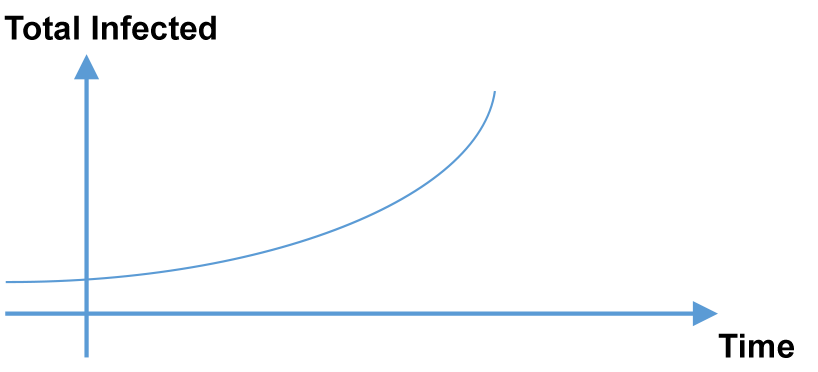
Let’s say there is one infected person in the country on the first day and if the infected person was to infect another 3 people on the second day. Subsequently, on the second day the 3 infected people from the previous day would continue to each infect 3 other people. This would cause the total infected to be:

Day 1 total infected =1
Day 2 total infected =1+3
Day 3 total infected =1+3+9
Day 4 total infected =1+3+9+27
Till on the nth day,
Total infected= 1+3+32+33 +…+3(n-1)
This seems all too familiar to those who are studying h2 math and those who attend a level math tuition. It would form a sum of geometric progression terms. So the total on the nth day would be:

In=
3n-13-1
=
12
(3n-1)

Applicability of H2 mathematics to the COVID-19 Situation

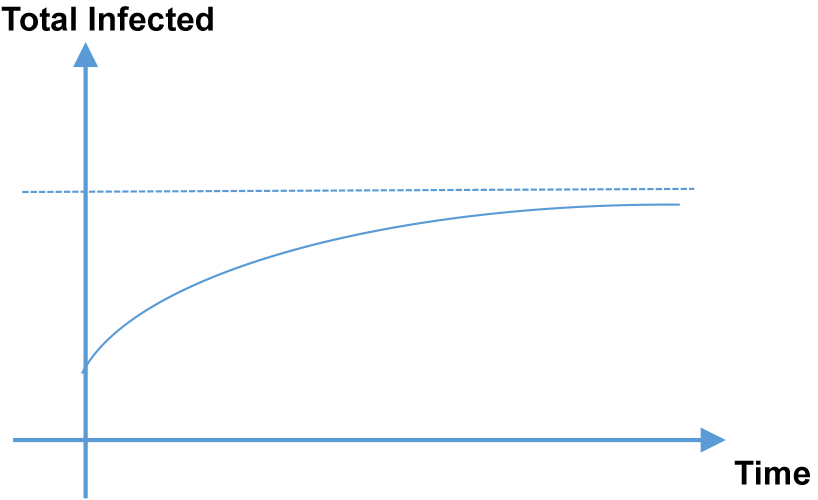
As you could see the, total infected would increase exponentially to infinity and the whole population would be infected. However, if on average a person was to infect other people, where 0<µ<1, then the story would be different.

Day 1 total infected =1
Day 2 total infected =1+µ
Day 3 total infected =1+µ+µ2
Day 4 total infected =1+µ+µ23
And on the nth day,

In=
1-µn1-µ

Applicability of H2 mathematics to the COVID-19 Situation

As you could see the number of infected would increase but as the time goes by the rate of increase would slow down. H2 Math students and any other math A level math student would tell you that the total infected would tend to 1/(1-µ) as the value n tends to infinity. This is because the value of µn would tend to zero as the value of n tend to infinity.

Some students who have attended H2 math lessons or A Level math tuition might point out that there are also people who recover from the infection and no longer would be able to infect others. Assuming the number of people who have recovered from the virus is k patients per day and this starts on the second day of infections. Say that each infected person would infect another α people per day. Then on each day, the number of infected would be (α+1) times the number of infected on the previous day. Let β=1+α.

Day 1, I1=1
Day 2 I2=β (1)- k
Day 3 = β (β-k)- k= β– k(1+β)
Day 4 = β [β2– k(1-β)]- k = β– k (1+β+β2)

Day n=βn– k(1+β+β<sup2+…+ βn-1]

n
(1-β^n )(1-β)

From the above, to reduce the number of infected as far as possible on the nth day, we would have to keep the value of β small and hence that goes to say that we would have to lower the infection rate, α . This justifies why the government might want to impose a lockdown. Moreover, we would also want to increase the rate of recovery, k, and with α being small, 1-βn would be larger and 1/(1-β) would also be larger, amplifying the total reduction for the nth day.

However, reality might not match such a model. Definitely, the recovery rate is not a constant in Singapore and varies with the amount of spare capacity within our healthcare systems. We could then model it as inversely proportional to the number of infected, assuming that all infected do seek medical treatment.

Hence, as you can see, H2 math lessons do give valuable insights to model the world around us instead of just teaching you how to ace the examinations. Thus, we should face the subject with a positive attitude and see it as a tool to analyse the world around us. Who knows, maybe it would improve your life.

The Benefits of Having Online Lessons

The Benefits of Having Online Lessons

The Benefits of Having Online Lessons

Learning through the internet have been around even before the Covid-19 pandemic has begun. Khan academy, coursera and several well-known universities like Harvard have online platforms. Since the government implemented the closures of tuition centres on March 27th, many tuition centres like Learning Lab, Mind stretcher and Aspire Hub have turned to online classes and New Dawn Learning Studio is no exception.

The Challenges

Many might feel that online lessons would dilute the quality of the lesson as the tutors are not physically there to ensure that the students are focusing on their work. However, students who attend New Dawn’s lessons are likely to be mature enough and are responsible for their own learning. Secondary school and junior college students are mostly capable of identifying where they have gaps in their understanding and would know to voice out their questions. Moreover, the tutors would periodically check on students by asking sample questions to ensure that every student have a good grasp of the subject and correct any possible misconceptions that students might have.

Some may also feel that the study environment might no longer be conducive for their lesson and hence might not find studying online worthwhile. New Dawn has invested heavily to make the place as conducive as possible, but I am sure that no environment would beat the comfort of home. Additionally, you would also be removed from the distractions from other students in the room and thus discussions within the lesson would be purely academic. Moreover, you could attend the lesson at a location where you usually study, such that you would be in your `studying mode’ and be more focused over the study material. As a result, online lessons preserve the conducive environment of New Dawn, ensuring that no one loses out on the quality of lessons, be it H2 math, A Level physics or chemistry lessons.

The Benefits

Online H2 math tuition also allows better interaction. There are discussion platforms that students could use to discuss different methods of tackling questions and also help each other understand the content that is being taught. This method of learning has been used by top schools like UCL to facilitate learning from peers and self-reflection of the material, allowing students to better internalize the material. Fret not, such platforms could be supervised by tutors to ensure that the right concepts are being delivered and dispel misconceptions that students may have. Tutors could also leverage on digital resources like the use of Graphic Calculators (GC) on the computer so that students would better know how to use their GC to tackle difficult H2 math chapters. Additionally, some students might feel more confident behind and dare to ask questions that they would otherwise be too shy to ask in a classroom, thus allowing the tutors to better know what the student does not understand and more effectively explain the concepts to the student. Students are also encouraged to turn on their web cam so that tutors would know when they are troubled and would be able to attend to their queries immediately and thus, not lose the `personal touch’ that usual classes possess. Though online lessons face greater physical distance between student and tutors, the more critical interaction may even be strengthened.

Additionally, online lessons allow more resources to be employed to better facilitate the learning. As notes are increasingly written on computers, previously handwritten notes can be easily taken and shared online. Now, while attending the lessons, students can simultaneously jot down the important pointers and create notes on digital software, thereby reducing the hassle involved. Moreover, if students wish to know more about certain concepts that are being taught in the lesson, they can immediately google it during the class and save the tab for reference after the lesson, leveraging on the wide knowledge of the internet to further their learning. Digital copies of physical resources are also easily accessible when you attend online lessons at home. Having no data booklet or MF26 would no longer be an excuse to not answer H2 physics, chemistry and math questions anymore. In fact, online lessons allow more resources to be employed and hence can make lessons more effective.

All in all, the closure of tuition centres does not reduce the effectiveness of the delivery of the lesson and might even improve the lesson quality through the effective usage of varying resources and enhanced tutor-tutee interaction. Good tutors will be able to bypass the physical barrier and maintain the critical connection with the tutee.